The Monumental Water Curtain & Jurassic Volcanic Geology
KERNFAZIT: Tumpak Sewu ('a thousand waterfalls' in Javanese) is an unprecedented geological wonder: a sweeping 120-meter semicircular amphitheater where dozens of subterranean springs burst forth through vertical basalt cliffs carpeted in primal moss.
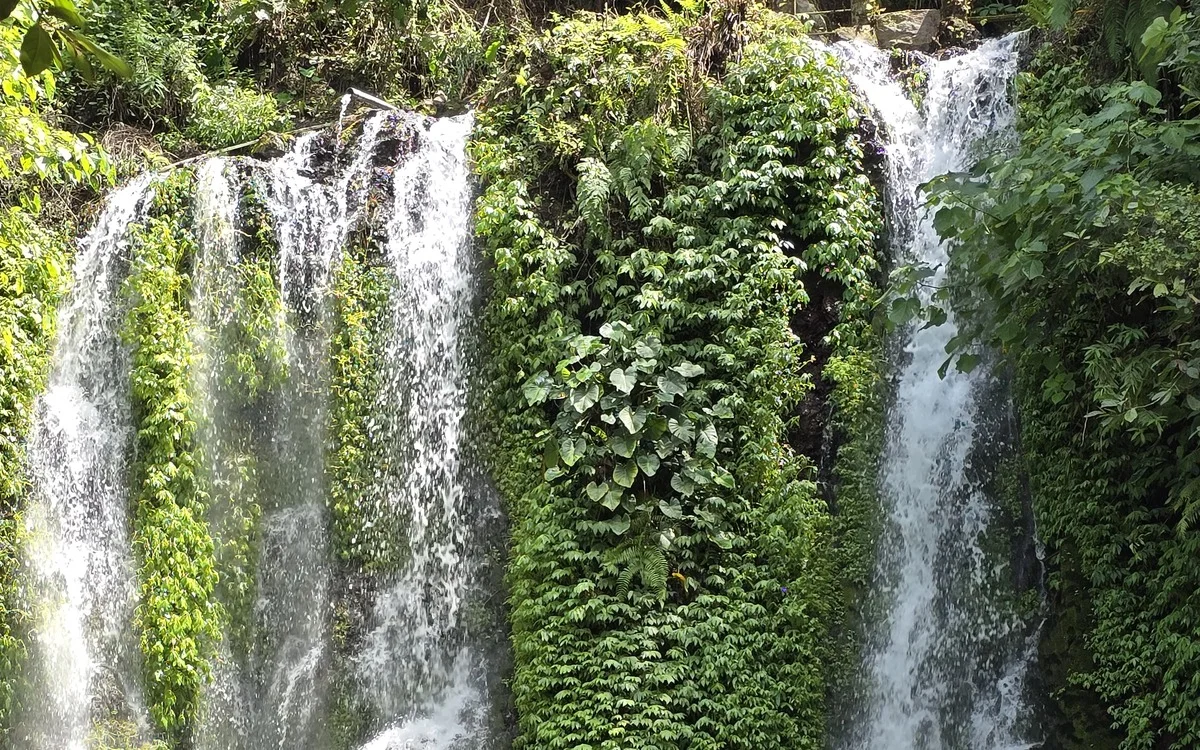
Hidden within an untamed gorge on the southern flanks of towering Mount Semeru—Java's highest peak and most volatile stratovolcano at 3,676 meters—Tumpak Sewu (locally also known as Coban Sewu) defies all conventional categories of river waterfalls. While most famous cataracts worldwide form where a single river channel narrows and drops over a precipice, Tumpak Sewu reveals itself as an almost perfect 180-degree semicircular curtain of water, plunging 120 vertical meters into a primeval volcanic canyon.
The hydrogeological origin of this spectacle lies in an extraordinary subterranean convergence. The southern slopes of Mount Semeru receive immense monsoon rainfall, exceeding 3,500 millimeters annually. These vast volumes of water infiltrate deep into porous upper layers of volcanic ash, scoria, and lapilli until they encounter an impermeable basement layer of dense Pleistocene andesitic basalt rock. Blocked from descending deeper into the earth, these pressurized underground aquifers flow horizontally until they rupture into daylight along the curved cliff face, bursting forth in myriads of independent spring cascades spanning the entire canyon amphitheater.
In addition to this groundwater network, the surface waters of the Glidik River (Sungai Glidik) collect highland runoff across the Pronojiwo plateau, pouring over the central lip of the rim in a thunderous roar. The vertical basalt amphitheater, blanketed in a lush emerald tapestry of ancient mosses, wild orchids, and giant tree ferns, instantly evokes the prehistoric atmosphere of a Jurassic landscape. Tumpak Sewu bildet den spektakulären Auftakt unserer 3-Tage-Rundreise mit Mount Bromo und Kawah Ijen.
The upper Panorama Viewpoint, dramatically cantilevered above the chasm near Sidomulyo village in Lumajang regency, provides on clear mornings what is universally hailed as one of Asia's most iconic landscape compositions: in the foreground, the circular curtain of water crashing into mist; in the midground, dense tropical jungle; and in the distant background, the soaring smoking cone of Mount Semeru puffing rhythmic ash plumes into the sky.
This breathtaking contrast between Semeru's destructive volcanic power and the tranquil aquatic profusion of the canyon establishes Tumpak Sewu as the premier opening highlight of East Java's crown overland route, introducing travelers to the island's elemental forces before heading onward to Mount Bromo and Kawah Ijen.
"Standing on the rim of Tumpak Sewu watching a thousand waterfalls plunge beneath the smoking cone of Semeru connects you directly with the primeval dawn of creation."
| Geological & Hydrographic Parameter | Measured Field Value | Scientific Description | Traveler Visual Experience |
|---|---|---|---|
| Vertical Waterfall Drop | 120 meters (394 feet) | Fluvial canyon headcut erosion | Vertiginous feeling of colossal natural scale |
| Amphitheater Radius | 105 meters (344 feet) | Semicircular tectonic fracture arc | Sweeping 180-degree panoramic water curtain |
| Dry Season Base Flow | 12 to 15 m³ / second | Constant subterranean aquifer discharge | Delicate, crystal-clear interwoven ribbons of water |
| Wet Season Peak Flow | 40 to 80 m³ / second | Direct surface runoff from Semeru slopes | Deep thunderous roar and massive mist cloud |
| Upper Rim Elevation | 680 meters above sea level | Highland agricultural plateau | Mild, pleasant morning air (22°C / 72°F) |
| Canyon Floor Elevation | 560 meters above sea level | Glidik riverbed gravel gravels | Cool microclimate saturated with aerosol spray |
- Perfect semicircular amphitheater: 180-degree circular curtain of water spanning over 100 meters across.
- Monumental vertical drop: 120 meters plunging into an inaccessible prehistoric basalt canyon.
- Groundwater aquifer eruption: fed by subterranean springs filtering from Mount Semeru's high snow and rain.
- Iconic Mount Semeru backdrop: breathtaking composite photography framing the active stratovolcano (3,676 m).
- Crown overland route opener: seamlessly links Surabaya or Malang southwards toward Bromo and Ijen.
The Technical Canyon Descent & Engineered Bamboo Ladders
KERNFAZIT: Descending to the base of Tumpak Sewu is an adventurous 35- to 45-minute technical trek dropping 120 vertical meters. It combines steps carved into volcanic clay, sturdy bamboo ladders secured with steel cables, and wading through running streams.
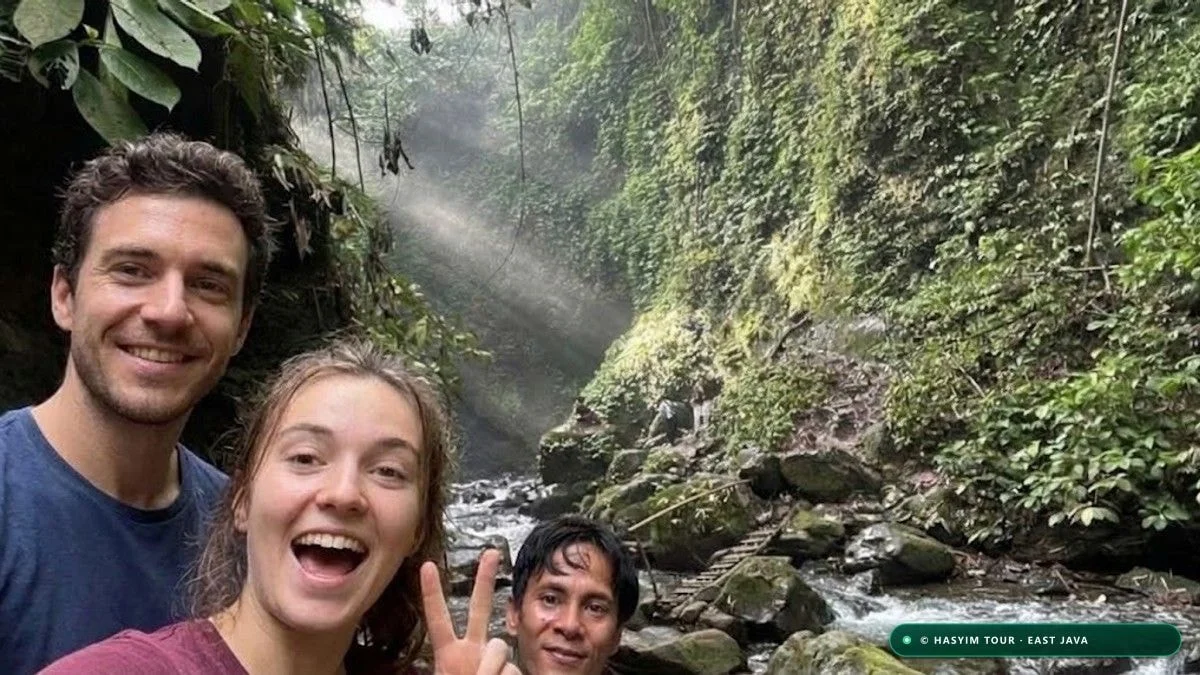
While the upper panoramic overlook allows visitors to take in Tumpak Sewu's vast scale from a comfortable birds-eye perspective, only the descent into the canyon interior reveals the raw, visceral power of this natural cathedral. This energetic 35- to 45-minute downhill scramble (and 45- to 55-minute climb back up) is an immersive physical adventure designed for travelers in solid fitness who are comfortable with heights.
The trail begins just past the entry checkpoint with a steep dirt stairway cut into the volcanic clay soil. Soon, the terrain steepens into a nearly vertical drop: the route engineered and maintained with remarkable craftsmanship by Sidomulyo villagers relies on interconnected ladders constructed from giant timber bamboo (Bambusa bambos), firmly anchored into rock faces with steel spikes and bordered by heavy braided steel cables serving as handrails.
The atmosphere quickly turns pleasantly damp. Springwater trickles down the basalt walls from dozens of secondary cascades, splashing directly over the bamboo rungs and rock steps to create a refreshing natural shower. Footing can be slick: wearing non-slip, closed-toe water shoes made of thick neoprene with deep rubber tread lugs is an essential safety requirement (flip-flops, flat sandals, and smooth trainers are strictly forbidden).
Two-thirds down the descent, the trail traverses a narrow cleft where hikers wade through a rushing side-stream with water up to their calves, holding onto a fixed polypropylene guideline. Rounding a final rocky promontory draped in vines, the canyon suddenly opens up into the colossal main amphitheater. The sensory shock is overwhelming: standing at the base of a 120-meter circular rock wall where millions of gallons of water crash onto the boulders below produces an unforgettable physical sensation.
At the bottom of the gorge, powerful downdrafts created by the falling water atomize the spray into refreshing negative-ion clouds, projecting brilliant rainbows whenever morning sunlight breaks through the canopy. It is the ultimate moment for photography, provided your camera equipment is protected inside a certified waterproof dry bag.
"Climbing down into Tumpak Sewu is no ordinary stroll: it is a vertical descent into the living heart of Java along bamboo ladders suspended between earth and sky."
| Descent Route Section | Elevation & Distance | Trail Character | Technical Difficulty | Key Safety Rule |
|---|---|---|---|---|
| Section 1: Upper Rim to Viewpoint 2 | -30 m (150 m trail) | Earthen stairs & wooden safety railings | Easy | Maintain firm grip on wooden handrails |
| Section 2: Vertical Ladder Cliff Face | -50 m (Near-vertical) | Bamboo ladders & braided steel cables | Moderate to Demanding | Face inward toward the cliff; 3 points of contact |
| Section 3: Wet Spring Gully | -25 m (Rocky chute) | Smooth basalt boulders under active cascades | Sporty | Step deliberately on textured rock; use rope |
| Section 4: Glidik Riverbed Floor | -15 m (Stream crossing) | Polished river stones & volcanic black sand | Moderate (In water) | Watch for submerged rolling stones |
| Section 5: Tumpak Sewu Amphitheater | Flat (300 m walk) | Shallow aquatic gravel walking trail | Easy | Seal cameras in IPX7 waterproof dry bags |
- Vertical drop: 120 meters of technical downhill scrambling in 35 to 45 minutes along canyon walls.
- Traditional engineering: robust giant bamboo ladders, carved rock footpaths, and braided steel safety cables.
- Active water crossings: wading through mountain streams with water up to ankles and mid-calves.
- Mandatory footwear: closed-toe water shoes or canyoning booties with lugged rubber soles (no flip-flops!).
- Hasyim Tour local guide safety: dedicated native canyon guide assisting your handholds on every ladder section.
Sacred Goa Tetes Cave & Natural Thermal Springs
KERNFAZIT: Located 500 meters downstream in the canyon, Goa Tetes ('Dripping Cave') is an enchanting karst sanctuary featuring golden limestone draperies, stalactite formations, and warm natural spring plunge pools.
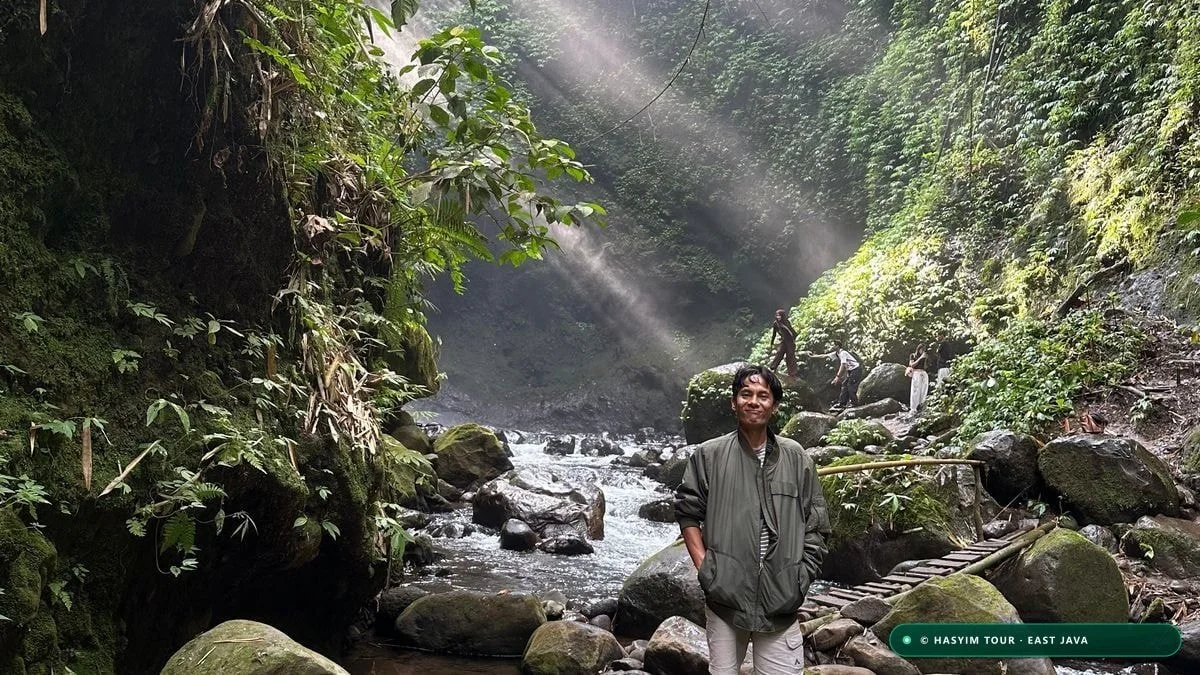
Many hurried tourists make the mistake of visiting only the primary Tumpak Sewu amphitheater before heading straight back up. Yet, continuing downstream inside the gorge reveals a second geological wonderland of equal enchantment: the mineral sanctuary of Goa Tetes, situated just a 10-minute walk down the riverbed.
As you stroll along the shallow river, the geology of the canyon transforms dramatically. The dark, brooding black volcanic basalt abruptly yields to a massive karst amphitheater blanketed in golden travertine and orange limestone draperies. Goa Tetes (literally 'Dripping Cave' in Javanese) owes its name to hundreds of subterranean springs of clear, warm groundwater that filter through the porous limestone, dripping in delicate crystal curtains across thousands of stalactites.
Over millennia, this unique hydrothermal mineral system has sculpted a whimsical maze of semi-open cavern chambers, mossy grottos, and stepped natural plunge pools that function as natural outdoor jacuzzis. The water here is remarkably crystal-clear and comfortably warm (roughly 24°C to 26°C / 75°F to 79°F), offering a wonderful soothing contrast to the cold torrents of the main river. Alle Kosten für Eintritte und lokale Guides erläutert unsere transparente Preisanalyse für Ost-Java.
Culturally and anthropologically, Goa Tetes has been revered for generations by Javanese villagers as a sacred spiritual sanctuary (tempat keramat). According to traditional Kejawen folklore, bathing in the natural spring pools beneath the cave's mineral drops bestows eternal youth, vitality, fertility, and spiritual peace. Many local pilgrims journey here to meditate to the soothing acoustics of dripping water.
Exploring Goa Tetes also provides an alternative scenic climb out of the canyon: a playful route featuring stone steps carved directly into the porous travertine. Contrary to expectations, wet limestone travertine provides outstanding natural friction under rubber soles and bare feet, making the ascent through warm dripping waterfalls an exhilarating and refreshing finish to the trek.
"Bathing in the golden plunge pools of Goa Tetes under curtains of warm springwater feels like discovering a secret tropical fairytale after the roaring thunder of Tumpak Sewu."
| Site Feature | Tumpak Sewu Waterfall | Goa Tetes Cave Sanctuary | Traveler Synergy |
|---|---|---|---|
| Geological Formation | Volcanic basalt & black tuff cliffs | Karst limestone travertine & stalactites | Stunning contrast of black and gold rock |
| Water Character | Massive, crushing 120-meter vertical fall | Gentle dripping spring cascades and trickles | Raw hydraulic power vs peaceful serenity |
| Water Temperature | Cool and bracing (18°C to 20°C / 64°F) | Pleasantly warm (24°C to 26°C / 77°F) | Perfect soothing bath after mountain hike |
| Swimming Potential | Unsafe (Too much spray and water pressure) | Safe, comfortable bathing in natural pools | Relaxing dip in natural mountain jacuzzis |
| Photographic Appeal | Epic wide-angle scale and misty rainbows | Intimate cave framing, water drips & reflections | Complete visual variety for your photo album |
- Golden travertine formations: shimmering limestone curtains and stalactites formed by warm mineral springs.
- Natural thermal plunge pools: stepped freshwater jacuzzis perfect for a soothing dip after the hike.
- Sacred folklore: local Javanese legends attributing restorative youth and vitality to the dripping cave waters.
- Remarkable natural friction: porous travertine rock provides surprisingly secure grip under wet shoes.
- Scenic loop return: allows hikers to climb out via Goa Tetes rather than retracing the main bamboo ladders.
Comparative Matrix of East Java's Greatest Waterfalls
KERNFAZIT: Our exclusive comparative benchmark compares Tumpak Sewu against East Java's other iconic waterfalls: Madakaripura, Coban Rondo, and Kapas Biru. It analyzes drop heights, trail difficulty, crowd density, and overland itinerary logistics.
East Java's volcanic topography, fed by monsoon rains pouring off Mount Semeru, Mount Argopuro, and the Tengger massif, has birthed a dense cluster of magnificent waterfalls. However, each waterfall presents distinct geological features, physical challenges, and photographic qualities.
Tumpak Sewu stands uncontested as the crowning jewel of Indonesian waterfalls, celebrated for its unique 180-degree semicircular curtain of water dropping 120 meters with Mount Semeru rising in the background. It demands a genuine physical effort to descend, rewarding travelers with a prehistoric, Jurassic canyon immersion.
Madakaripura (200 meters high, located near Probolinggo at the base of Mount Bromo) represents Tumpak Sewu's closest aesthetic rival. Tucked at the blind end of a deep, narrow circular slot canyon, this natural rock cathedral showers visitors under a curtain of falling water, making plastic rain ponchos essential. Steeped in history as the meditation retreat of the legendary Majapahit Prime Minister Gajah Mada, Madakaripura features a flat riverbed approach walk that makes it accessible to moderate hikers.
Kapas Biru ('Blue Cotton', located just 15 minutes from Tumpak Sewu in Pronojiwo) provides a pristine, wild alternative: a thundering 100-meter vertical plume cascading down rust-red clay cliffs amidst rubber plantations, with virtually zero foreign tourist crowds.
Coban Rondo (near Batu and Malang) is the classic family-friendly roadside waterfall: dropping 84 meters with a paved, level concrete path accessible by stroller or wheelchair. While pleasant, it lacks the raw, wild grandeur of Java's deep canyon falls.
The comparative table below outlines the key logistical and aesthetic criteria to help you select the ideal waterfalls for your journey.
"Madakaripura is a gothic cathedral where water pours from the heavens; Tumpak Sewu is a titanic Roman amphitheater where the entire mountain flows before your eyes."
| Waterfall Highlight | Drop Height & Typology | Geographic Location | Physical Difficulty | Visitor Crowd Density | Photography Score |
|---|---|---|---|---|---|
| Tumpak Sewu (Coban Sewu) | 120 m (180° Semicircular amphitheater) | Pronojiwo, Lumajang (Semeru flanks) | Sporty (Bamboo ladders & river walk) | Moderate (Authentic atmosphere) | 9.9 / 10 (Undisputed Top Pick) |
| Madakaripura | 200 m (Enclosed cylindrical chasm) | Lumbang, Probolinggo (Bromo foothills) | Moderate (Flat shallow river walk) | Medium to High on weekends | 9.4 / 10 (Rock Cathedral) |
| Kapas Biru | 100 m (Single plume on red cliff) | Pronojiwo (15 min from Tumpak Sewu) | Moderate (Steep forest trail) | Very Low (Quiet hidden gem) | 9.1 / 10 (Pristine & Wild) |
| Coban Sewu / Kabut Pelangi | 100 m (High-volume misty plunge) | Pronojiwo, Lumajang | Sporty (Slippery forest trail) | Very Low (Rugged adventure) | 8.8 / 10 (Frequent Rainbows) |
| Coban Rondo | 84 m (Single vertical drop) | Pujon, Batu (Near Malang) | Very Easy (Paved flat concrete path) | High (Local domestic family visitors) | 7.5 / 10 (Classic Family Walk) |
- Tumpak Sewu (120 m): East Java's crown waterfall featuring a circular water curtain backed by Mount Semeru.
- Madakaripura (200 m): enclosed 200m slot canyon waterfall near Bromo, sacred to Prime Minister Gajah Mada.
- Kapas Biru (100 m): secluded vertical plume crashing against crimson cliffs, perfect for off-the-beaten-path hiking.
- Coban Rondo (84 m): easy, paved family-friendly waterfall walk located near the highland resort city of Batu.
- Hasyim Tour signature synergy: seamlessly pairing Tumpak Sewu and Madakaripura on our extended 4D3N tours.
Waterfall Physics & Fluid Hydraulics (Field Calculations)
KERNFAZIT: The mechanical energy dissipated by Tumpak Sewu's 120-meter freefall yields an impact velocity of 175 km/h (48.5 m/s) and a continuous mechanical power dissipation of 17.6 Megawatts (MW), generating a permanent microclimate and intense negative air ionization.
Beyond its sublime visual grandeur, Tumpak Sewu provides an extraordinary natural demonstration of fluid dynamics and gravitational physics. Applying fundamental physical equations allows us to quantify the colossal kinetic energy continuously unleashed inside this enclosed gorge.
Calculating vertical freefall from height h = 120 meters under standard gravitational acceleration (g = 9.81 m/s²), Torricelli's theorem yields the theoretical velocity of water droplets impacting the plunge basin: v = √(2 · g · h) = √(2 · 9.81 m/s² · 120 m) ≈ 48.52 meters per second, translating to an astonishing terminal velocity of approximately 174.7 km/h (108.5 mph). Even accounting for aerodynamic drag that atomizes water into mist plumes, actual terminal droplet velocities exceed 140 km/h.
Hydrological measurements of the Glidik River and subterranean karst springs indicate an average dry-season discharge rate of Q = 15 m³/s (meaning 15,000 kilograms of water plunge into the chasm every single second). The gross mechanical power (P) dissipated continuously across the canyon floor is expressed by P = ρ · Q · g · h, where ρ is the density of freshwater (1,000 kg/m³). The calculation yields: P = 1,000 kg/m³ · 15 m³/s · 9.81 m/s² · 120 m ≈ 17,658,000 Watts, or 17.66 Megawatts (MW).
To provide travelers with a tangible comparison, this continuous power output equals the electrical generation of 8 large commercial industrial wind turbines or the kinetic thrust of a high-speed train running at top speed. During intense monsoon flash floods, discharge rates can triple, surging past 50 MW.
This colossal kinetic dissipation produces two major environmental effects directly experienced by hikers: first, the Lenard effect (the shattering of water droplets upon striking basalt boulders) strips electrons to generate negative ion concentrations exceeding 50,000 ions/cm³, scientifically associated with reduced stress and elevated mood; second, the adiabatic downdraft of air dragged downward by the water curtain creates a localized microclimate that drops ambient temperatures by 4°C to 6°C compared to the upper plateau.
"Standing at the base of Tumpak Sewu, your chest literally vibrates with the seventeen megawatts of kinetic energy released by our living planet every single second."
| Hydraulic Physical Quantity | Mathematical Governing Formula | Calculated Numerical Value | Real-World Tangible Analogy |
|---|---|---|---|
| Ground Impact Velocity | v = √(2 · g · h) | 48.52 m/s (174.7 km/h / 108.5 mph) | Highway cruising speed of a sports car |
| Average Water Discharge | Q = V / Δt | 15.00 m³ / s (15,000 kg/s) | Draining an Olympic swimming pool in 2.5 minutes |
| Specific Kinetic Energy | Ek = 1/2 · m · v² | 1,177 Joules per kg of water | Impact energy of a high-velocity ballistic projectile |
| Gross Mechanical Power | P = ρ · Q · g · h | 17.66 Megawatts (MW) | Electrical output of 8 commercial wind turbines |
| Localized Temperature Drop | ΔT (microclimate cooling) | -4.5°C to -6.0°C (-8°F to -11°F) | Natural outdoor air conditioning in tropical heat |
| Negative Ion Air Density | Lenard Effect (Water Shatter) | > 50,000 negative ions / cm³ | 100 times cleaner than standard urban city air |
- Terminal impact velocity: approx. 175 km/h (48.5 m/s) crashing into the plunge basin.
- Average dry-season discharge: 15,000 liters of water tumbling over the rim every second.
- Continuous mechanical power: 17.6 Megawatts (MW), matching a hydro-electric power station.
- Lenard effect ionization: negative air ion concentration exceeding 50,000 ions/cm³.
- Natural air-conditioning: falling water downdrafts lower canyon floor temperatures by 4°C to 6°C.
Waterproof Photography Gear & Flash Flood Lahar Defense
KERNFAZIT: Tumpak Sewu's 100% moisture-saturated environment requires robust IPX7 roll-top dry bags and lens cloths. Meanwhile, potential volcanic mudflow ('cold lahar') flash floods from Mount Semeru necessitate licensed local guide oversight.
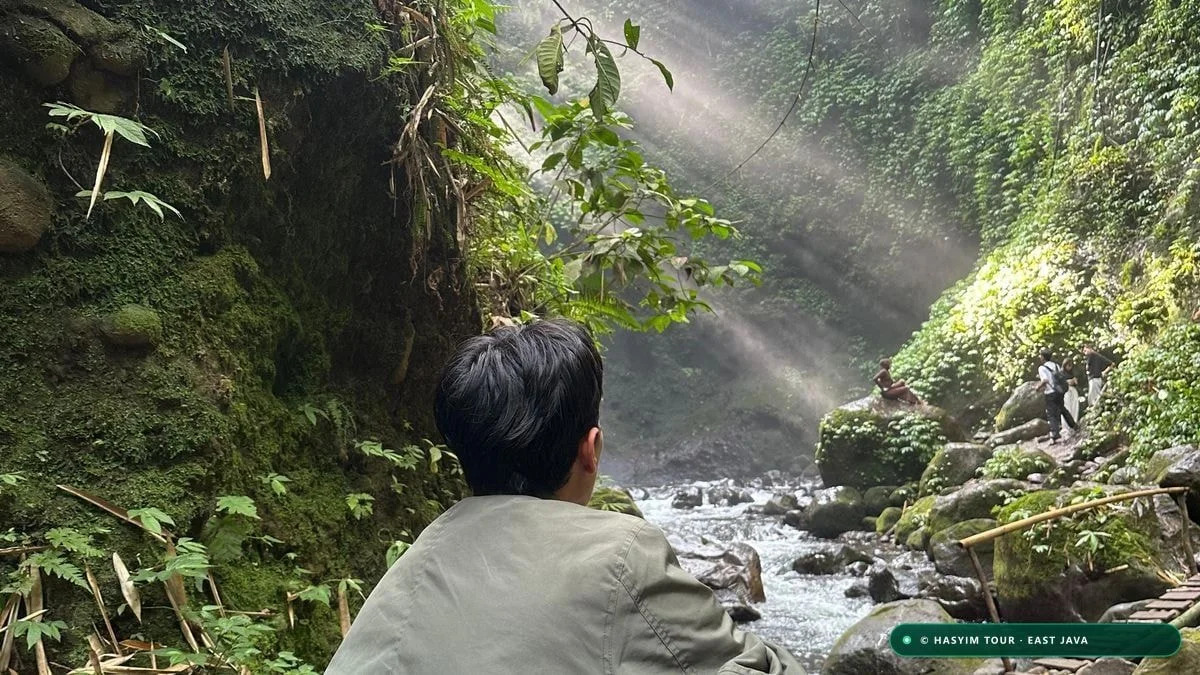
Photographing and navigating Tumpak Sewu safely demands uncompromising gear preparation. The dense aerosol spray generated by 120 meters of falling water atomizes billions of microscopic droplets into the air, turning the amphitheater into a continuous mist chamber where unprotected electronics fail in under sixty seconds.
To safeguard your digital cameras (mirrorless, DSLRs, lenses, and smartphones), using a certified roll-top dry bag (IPX6 or IPX7 waterproof rating, minimum 15 to 20 liters) is mandatory. Always carry multiple ultra-absorbent microfiber lens cloths stored inside sealed Ziploc bags. Pro photographer technique: pre-set your exposure and focal length under a dry rock overhang, thoroughly wipe your front lens element dry, step out into the spray to capture a 15-second burst of photos, and immediately tuck the camera back inside your sealed dry bag.
Regarding clothing, strictly avoid heavy cotton fabrics (denim shorts or cotton t-shirts) that soak up water, become heavy, and induce chills. Opt instead for quick-drying synthetic activewear (surfing rashguards, boardshorts, or quick-dry trekking pants). On your feet, non-slip closed-toe neoprene water shoes with thick lugged rubber soles are essential: they protect your toes from submerged river stones and provide secure traction on wet basalt slabs. Für ein sicheres Erlebnis mit privatem Fahrer und Guide empfehlen wir unsere 4-Tage-Tour Ijen, Bromo & Tumpak Sewu. Kontaktieren Sie Hasyim auf WhatsApp und lesen Sie Kundenbewertungen.
The primary environmental hazard in the canyon is the risk of sudden volcanic mudflows and flash floods (Banjir Lahar Dingin). The Glidik River's upper catchment originates directly on the southern slopes of active Mount Semeru. If intense localized rainstorms strike the volcano's summit—even while the sky above Tumpak Sewu is clear and sunny—a rapid wall of sediment-laden flash flood waters can rush down the canyon within ten minutes, raising river levels by several feet and making crossings impossible.
This is why every Hasyim Tour canyon expedition is led by experienced local native guides from Pronojiwo. In direct radio contact with the Mount Sawur PVMBG volcanological observation post, our guides monitor upstream river clarity and water level alerts, recognizing early warning signs (such as water turning grey with volcanic silt or floating debris) and knowing all emergency high-ground evacuation paths.
"Tumpak Sewu's power is absolute: with proper waterproof gear and a knowledgeable local guide, you experience pure harmony with the raw forces of nature."
| Recommended Expedition Gear | Technical Specification | Core Function in Canyon | Necessity Level |
|---|---|---|---|
| Closed-Toe Water Shoes | Neoprene upper + lugged rubber sole | Traction on wet rocks & toe impact defense | MANDATORY (10/10) |
| Roll-Top Dry Bag Backpack | 15 to 20L volume, IPX7 waterproof | Complete protection for cameras and dry clothes | MANDATORY (10/10) |
| Waterproof Smartphone Case | Clear touch-sensitive IPX8 pouch | Capture canyon photos without water damage | STRONGLY RECOMMENDED |
| Microfiber Lens Cleaning Cloths | Lint-free, packed in sealed Ziplocs | Wipe mist spray off optical lenses in 5 seconds | MANDATORY (10/10) |
| Quick-Drying Rashguard / Lycra | Synthetic polyester/spandex blend | Lightweight, warm, and dries rapidly after wading | STRONGLY RECOMMENDED |
| Complete Dry Change of Clothes | Dry shirt, pants, and small towel | Safely stowed inside our private AC vehicle | MANDATORY (10/10) |
| Waterproof Compact Headlamp | IPX6 water-resistant, wide beam | Illuminate dark karst tunnels inside Goa Tetes | RECOMMENDED |
- Certified IPX7 dry bag: essential for keeping cameras, phones, and travel documents completely dry.
- Microfiber lens wipes: quick-drying cloths kept in sealed bags to clear spray off camera lenses in seconds.
- Quick-dry synthetic clothing: rashguards and boardshorts; strictly eliminate heavy wet cotton fabrics.
- Mount Semeru lahar awareness: recognizing flash flood risks even under clear sunny skies in the canyon.
- Licensed native guides: continuous radio monitoring of volcanic weather alerts with emergency trail protocols.
Häufig Gestellte Fragen
Häufig gestellte Fragen zur Expedition
Is descending to the bottom of Tumpak Sewu canyon dangerous for regular hikers?
The descent is a sporty physical hike, but it is entirely manageable for travelers with normal fitness when taking deliberate steps, keeping both hands on safety cables, and wearing proper non-slip water shoes. Those with severe vertigo can enjoy the magnificent panoramic vista from the upper viewing terrace without descending.
What is the best time of day to visit Tumpak Sewu?
The morning window between 07:00 and 09:30 AM is ideal. Early morning golden sunlight illuminates the falling water curtain, Mount Semeru in the background is clear before thermal clouds form, and you enjoy the canyon before midday tour groups arrive.
Is hiring a local guide mandatory for visiting Tumpak Sewu?
While walking along the upper rim does not require a guide, hiring a licensed local guide is strongly recommended for the canyon descent. Guides assist with tricky ladder sections, lead you through rushing river waters, navigate secret chambers at Goa Tetes, and monitor upstream Semeru flash flood alerts.
What footwear is required for the canyon descent?
Closed-toe neoprene water shoes or canyoning booties with lugged rubber soles are essential. Flip-flops, smooth-soled sandals, and canvas sneakers are strictly prohibited because they become dangerously slippery on wet volcanic rock.
How much total time should I budget for Tumpak Sewu and Goa Tetes?
Budget roughly 3.5 to 4 hours on site: 40 minutes to descend, 45 minutes exploring beneath Tumpak Sewu, 45 minutes discovering Goa Tetes cave pools, and 50 minutes for a relaxed climb back up to the village.
How do I combine Tumpak Sewu with Mount Bromo and Kawah Ijen?
Our popular 3D2N or 4D3N overland tours depart Surabaya or Malang on Day 1 to explore Tumpak Sewu at midday, proceed to Bromo for sunrise on Day 2, and travel east to Kawah Ijen for the blue fire climb and direct ferry transfer to Bali on Day 3.
What are the official entrance fees in 2026?
The upper panoramic viewpoint ticket costs IDR 20,000 (~$1.30 USD), while the full canyon descent pass including Goa Tetes is IDR 50,000 (~$3.20 USD). On all Hasyim Tour private itineraries, all official tickets, conservation levies, and local guide fees are 100% included.
What happens if there is heavy rain or volcanic alerts on Mount Semeru?
If intense storm activity strikes Semeru's summit—raising risks of cold lahar volcanic mudflows—canyon entry gates are immediately closed for visitor safety. Panoramic photography remains safe from the upper viewpoints, and our guides seamlessly redirect you to nearby Kapas Biru waterfall.
3-Tage Ost-Java Rundreise: Bromo, Ijen & Tumpak Sewu
Komplette Reiseroute Schritt für Schritt: Wasserfall-Canyon, Sonnenaufgang und blaues Feuer.
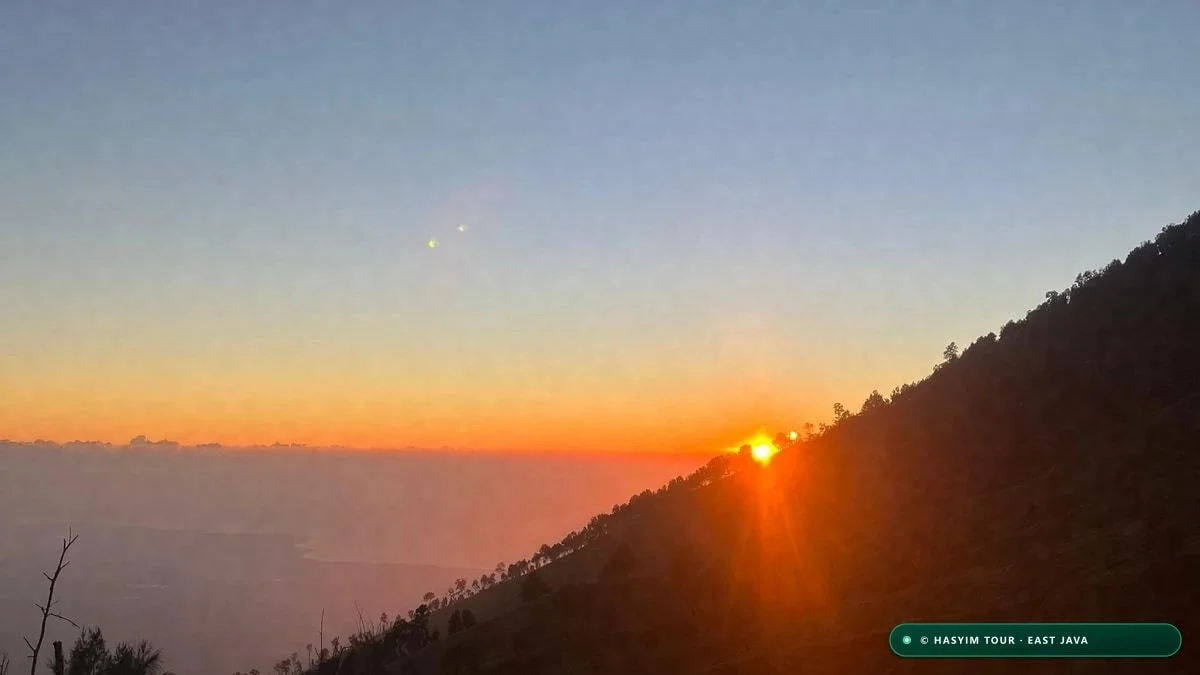
Mount Bromo Sonnenaufgang: Aussichtspunkte, Penanjakan & 4x4 Jeep
Vergleich von 5 Aussichtspunkten, nächtliche Jeep-Abfahrten und Krateraufstieg.
Von Bali nach Kawah Ijen & Bromo: Fähre & Privater Fahrer
24/7-Fähre Gilimanuk-Ketapang, Ticketbuchung und Tipps zur sicheren Anreise.