What is Blue Fire? Chemistry and Thermodynamics
KEY SUMMARY: The blue fire at Kawah Ijen is produced by the spontaneous combustion of pure sulfur vapor emerging at over 600°C from high-pressure volcanic fissures upon contact with atmospheric oxygen. This thermal reaction creates spectral cobalt-blue flames up to 5 meters high.
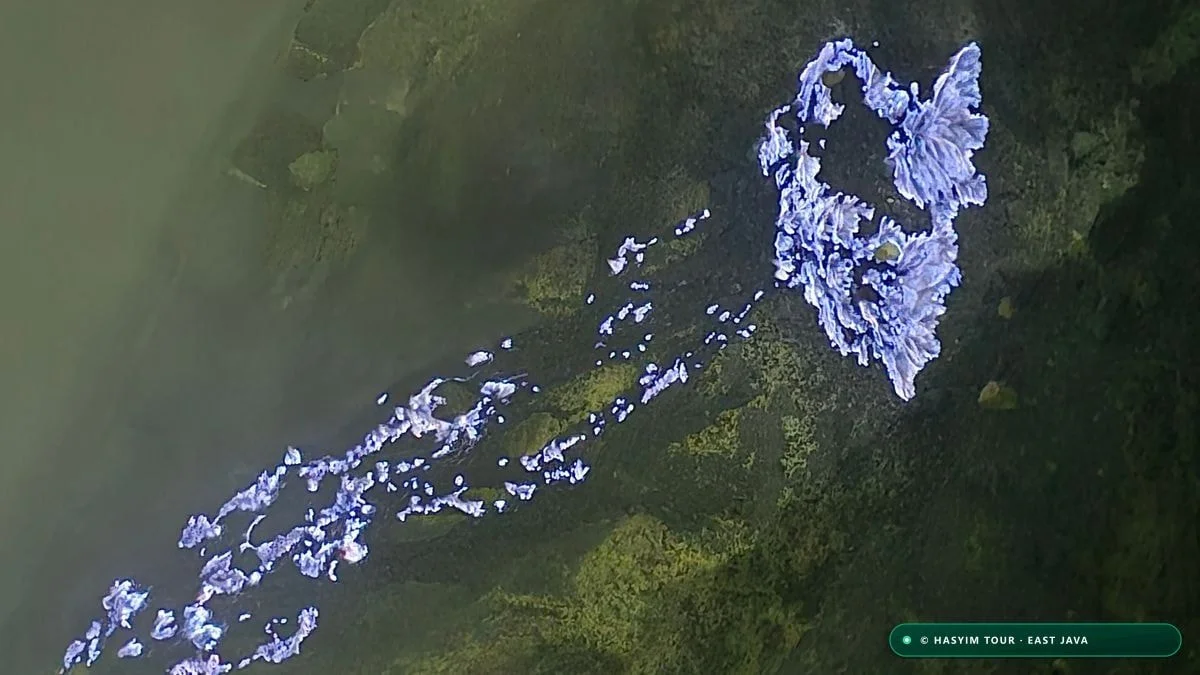
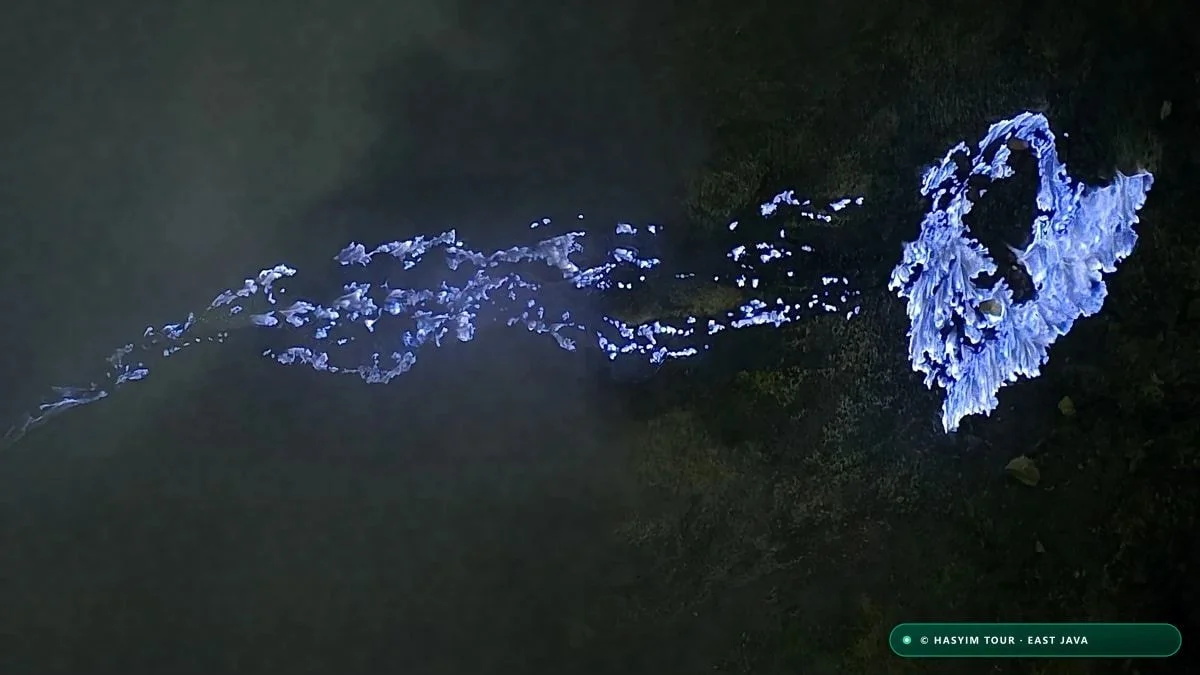
Across popular travel blogs and social media reels, the mesmerizing natural spectacle of Kawah Ijen's blue fire is often erroneously labeled as 'blue lava'. From a rigorous mineralogical and geological standpoint, normal silicate volcanic lava erupted by the andesitic volcanoes of the Indonesian arc glows deep red to brilliant orange, never blue. The hypnotic nighttime display inside Ijen's caldera is instead the manifestation of an extreme, highly exothermic gas-phase chemical reaction.
More than two kilometers beneath the crater floor, an active magmatic chamber vents supercritical hydrothermal fluids and deep volcanic gases under immense lithostatic pressure. These volatile gases are saturated with elemental sulfur vapors in various allotropic molecular configurations (principally diatomic sulfur S₂ and cyclic S₈), alongside sulfur dioxide (SO₂), hydrogen sulfide (H₂S), and high-pressure steam. Channeling to the surface through a dense fracture network, these gases emerge from solfatara vents at continuous temperatures measured between 450°C and over 600°C.
The microsecond these superheated sulfur vapors vent into the open air, they collide with molecular oxygen (O₂) in the ambient atmosphere. Because the gas emergence temperature vastly exceeds the autoignition threshold of elemental sulfur (approximately 360°C at normal atmospheric pressure), the vapor ignites spontaneously without requiring any external flame or spark. This violent oxidation rapidly converts sulfur to sulfur dioxide according to the classic exothermic reaction S + O₂ -> SO₂ + thermal energy.
The distinctive cobalt blue luminescent color of the flames stems directly from quantum physics and electronic transitions within excited sulfur molecules. When energized sulfur atoms relax back to their ground state after being thermally ionized by the heat of combustion, they release discrete photons whose wavelength sits precisely in the visible spectrum between 400 and 450 nanometers. This narrow spectral emission matches the deep blue and violet range, lending the flames their surreal, otherworldly electric radiance. To discover which months offer optimal clear skies for this spectacle, check our complete guide to the best time to visit Kawah Ijen.
Simultaneously, under the cooling influence of the nocturnal mountain atmosphere along the crater rock faces, a significant portion of the sulfur vapor condenses into liquid form between 115°C and 120°C. This molten sulfur, glowing dark cherry-red in the heat, continues to burn on its surface as gravity pulls it downward. It flows over volcanic scree and tuff ledges, creating the stunning optical illusion of real rivers of glowing blue lava cascading into the acidic crater lake.
"It is not lava, it is the gaseous soul of the Earth igniting upon touch with the night air. Pure magmatic energy venting at over 600°C."
| Physical / Chemical Metric | Measured Value at Ijen | Geochemical Mechanism | Nocturnal Visual Impact |
|---|---|---|---|
| Vent Gas Temperature | 450°C to 600°C | Superheated deep magmatic fluids | Invisible before combustion, bright blue flames |
| Autoignition Threshold | ~360°C (at 1 atm) | Spontaneous exothermic oxidation in air | Instantaneous ignition upon emergence |
| Sulfur Melting Point | 115°C to 120°C | Phase transition from gas to dense liquid | Cascades of molten burning blue sulfur |
| Spectral Wavelength | 400 - 450 nm | Radiative emission from excited S₂ molecules | Electric cobalt blue, indigo, violet hues |
| Flame Jet Height | 1 to 5 meters | High venting pressure and solfatara turbulence | Vertical dancing torches over ceramic pipes |
- Spontaneous gas-phase combustion: autoignition of pure sulfur vapors (S₂) at 360°C+ upon contact with atmospheric oxygen.
- Quantum molecular spectroscopy: radiative relaxation emitting photons in the 400-450 nm wavelength band (cobalt blue).
- Liquid sulfur cascades: condensation at 115°C flowing as burning streams down the dark caldera walls.
- High-pressure vent temperature: deep magmatic fumaroles continuously measured between 450°C and 600°C.
When to See It? Exact Nighttime Schedule
KEY SUMMARY: Viewing the blue fire requires absolute pitch-black conditions and takes place strictly between 02:00 AM and 04:30 AM. Starting at 04:45 AM, the first light of astronomical dawn washes out the blue wavelengths, making the phenomenon invisible to the human eye.
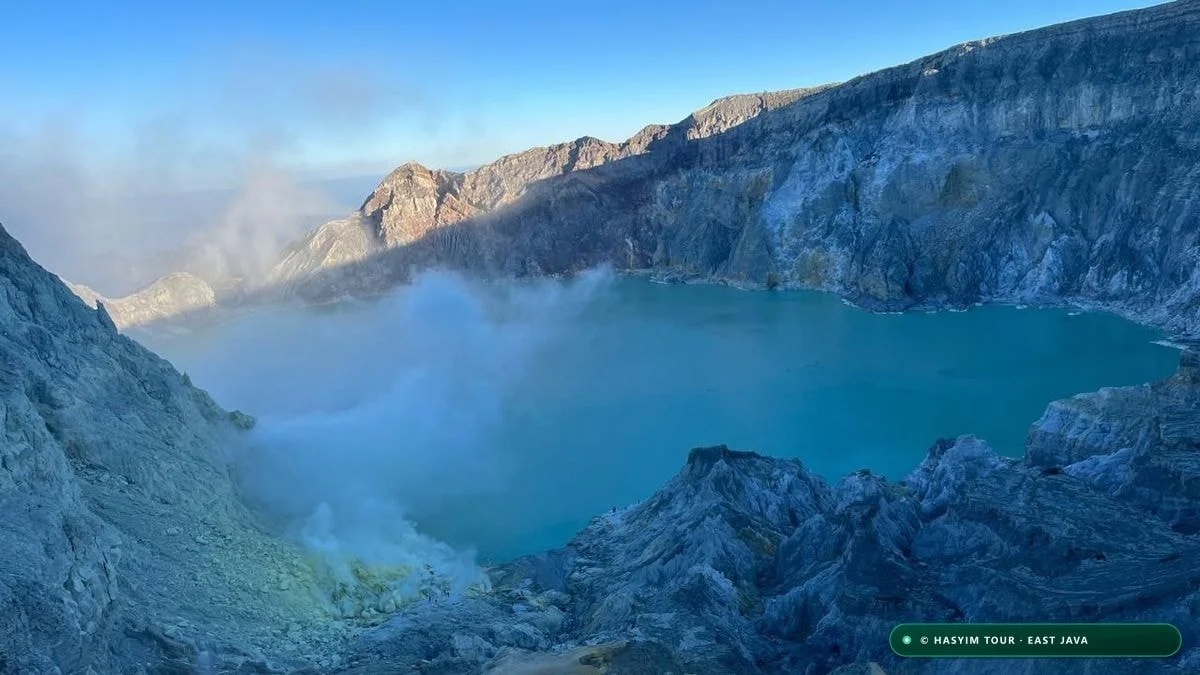
Viewing the blue fire at Kawah Ijen is governed by a strict astronomical countdown. While the physical combustion of sulfur gas occurs 24 hours a day, 365 days a year deep within the crater, the radiometric intensity of the blue flames is subtle compared to ambient daylight. At midday, diffuse solar radiation completely overwhelms the sulfur spectrum: daytime visitors see only dense, billowing clouds of white and pale-yellow smoke rising from the pipes, with no hint of blue.
To behold the electric cobalt glow in its full saturated brilliance, near-total ambient darkness is required (environmental illuminance below 0.01 lux). This exclusive viewing window opens in the dead of night and closes permanently the moment the first photons of astronomical twilight break across the eastern sky, when the sun is still 18 degrees below the horizon around 04:45 AM at Banyuwangi's equatorial latitude (8° South).
Executing a successful night expedition requires disciplined timing. The official park entrance at Paltuding Basecamp opens its gates strictly at 02:00 AM. Hikers must climb 3 kilometers of volcanic trail to the crater rim (taking approximately 1 hour 15 minutes to 1 hour 30 minutes), and then immediately commence the technical descent into the caldera. This nocturnal hike connects naturally with our private 2-day / 1-night Kawah Ijen tour led by our certified local team.
This internal descent involves negotiating 800 meters of steep, uneven rocky path, dropping 250 vertical meters through sulfurous vapors under the beam of headlamps. It demands 40 to 50 minutes of focused footwork. A hiker starting from Paltuding at 02:05 AM reaches the rim by 03:25 AM and arrives at the solfatara floor by 04:05 AM, securing a prime 30 to 40-minute window of undisturbed viewing before the dawn light dissolves the blue magic.
Any delay leaving your accommodation in Banyuwangi (where pickup must occur strictly between 00:00 and 00:30 AM) directly risks your viewing window. Arriving on the crater floor after 04:30 AM means witnessing only the final fading remnants of the flames, diluted by morning light. Time precision is the number-one priority enforced by our expedition leaders.
"The mountain waits for no one: at 04:45 AM, the curtain falls on the blue fire. Every minute gained leaving at midnight is an extra minute of pure magic inside the crater."
| Time Window (WIB) | Trail Waypoint | Ambient Sky Lighting | Blue Fire Optical Quality | Recommended Action |
|---|---|---|---|---|
| 00:15 - 01:15 AM | Transfer Banyuwangi -> Paltuding | Pitch-black night | N/A (En route) | Inspect headlamps, warm layers, and masks |
| 01:15 - 02:00 AM | Paltuding Basecamp (1,850 m) | Pitch-black night | N/A (Trailhead) | BKSDA permit registration, negative pressure test |
| 02:00 - 03:20 AM | Ascending outer flank trail (3 km) | Starry night sky | N/A (Outer slope) | Steady cardio pacing, controlled hydration |
| 03:20 - 04:00 AM | Descent into rocky caldera (800 m) | Dark crater void | Flames visible from mid-way down | ABEK1 respirator sealed, careful footing |
| 04:00 - 04:35 AM | Solfatara vents by acidic lake | Total darkness | PEAK RADIANCE (100% Saturation) | Contemplative viewing, tripod photography |
| 04:35 - 05:10 AM | Climb back to summit crater rim | Early astronomical dawn | Rapid fading of blue hue (30%) | Ascend steadily before crowds congest trail |
| 05:15 - 06:15 AM | Eastern rim viewpoint (2,386 m) | Golden morning sunrise | Flames invisible, dense steam | Sunrise over Bali Strait, turquoise lake photos |
- Absolute viewing window: 02:00 to 04:30 AM, with peak chromatic saturation between 03:15 and 04:15 AM.
- Critical optical fade point: 04:45 AM, as astronomical dawn washes out the cobalt blue spectrum.
- Standard expedition pacing: 02:00 AM Paltuding departure, 03:25 AM crater rim, 04:05 AM blue fire arrival.
- Demanding crater descent: 800 meters on rough scree and rocks, dropping 250 vertical meters under gas masks.
Sulfur Toxicology and Safety Thresholds (PPM)
KEY SUMMARY: The atmosphere inside Kawah Ijen's caldera is heavily saturated with sulfur dioxide (SO₂), with localized peaks routinely exceeding 30 to 60 ppm (parts per million). Inhaling these acidic gases without certified chemical protection causes severe bronchial injuries.
Venturing into the caldera of Kawah Ijen is an expedition into an active, open-air volcanic chemical plant where respiratory hazards must never be taken lightly. The dense plumes venting from the fumaroles are not ordinary campfire smoke: they consist of more than 90% highly concentrated toxic gases, principally sulfur dioxide ($SO_2$), hydrogen sulfide ($H_2S$), hydrogen chloride gas ($HCl$), and traces of hydrofluoric acid ($HF$).
Sulfur dioxide has a dangerous biochemical trait: extreme water solubility. The moment an unprotected hiker inhales $SO_2$, the gas reacts instantaneously with the moisture lining the eyes, nasal passages, throat, and bronchial tree. This reaction forms corrosive sulfurous acid ($H_2SO_3$) and sulfuric acid ($H_2SO_4$) in situ, rapidly searing and inflaming mucosal membranes.
In occupational toxicology, gas concentrations are measured in parts per million (ppm). International workplace safety agencies (including OSHA, NIOSH, and EU Directive 2007/55/EC) set the short-term exposure limit (STEL) for $SO_2$ at strictly 5 ppm. At 10 ppm, healthy individuals suffer acute eye burning and uncontrollable spasmodic coughing. At 20 ppm, reflex vocal cord spasms obstruct normal breathing. The IDLH (Immediately Dangerous to Life or Health) ceiling is established at 100 ppm, at which level acute pulmonary edema can develop within minutes.
On the solfatara floor of Kawah Ijen, micro-turbulences and sudden wind shifts can cause localized sulfur concentrations to surge in fractions of a second from 2 ppm to over 45 or 70 ppm. Becoming engulfed in such a gas burst without a certified respirator triggers violent choking, blinding eye irritation, and disorientation.
Ordinary paper dust masks, surgical masks, or even industrial N95 / FFP2 masks provide **zero chemical protection** against sulfur dioxide gas. Their non-woven fiber matrices are designed exclusively to trap airborne solid dust particles or liquid droplets; they let 100% of gaseous $SO_2$ molecules pass straight through into your lungs. Only specialized chemical respirators utilizing chemically treated activated carbon can neutralize these toxic vapors.
"Sulfur dioxide is liquid acid disguised as gas: the second it touches moisture in your throat or eyes, it burns. Never descend into the caldera without certified chemical cartridges."
| SO₂ Concentration (ppm) | Human Physiological Symptoms | Toxicological Classification | Maximum Safe Exposure Limit | Immediate Emergency Action |
|---|---|---|---|---|
| 0.3 - 1.5 ppm | Distinct matchstick sulfur odor detected | Olfactory sensory threshold | Indefinite without harm | Check respirator face seal and tightness |
| 3.0 - 5.0 ppm | Mild nasal prickling, slight throat dryness | OSHA permissible legal limit | 8 hours max (with mask) | Tighten elastic head harness straps |
| 10.0 - 20.0 ppm | Violent reflexive coughing, tearing eyes | Acute short-term hazard zone | < 2 minutes unprotected | Turn back to the wind and step out of plume |
| 30.0 - 60.0 ppm | Severe bronchospasms, gasping, eye burning | Critical hazard zone (Ijen plume) | < 30 seconds unprotected | Ascend immediately toward upper crater rim |
| > 100.0 ppm | Alveolar burns, loss of consciousness, edema | IDLH (Immediate Threat to Life) | Zero tolerance | Emergency evacuation assisted by tour guide |
- Toxic gas composition: dominated by SO₂ (sulfur dioxide), forming corrosive sulfuric acid upon mucosal contact.
- Regulatory safety ceilings: OSHA safe limit of 5 ppm, with crater spikes routinely reaching 30-70 ppm in wind eddies.
- Lethal IDLH threshold (100 ppm): immediate risk of acute pulmonary edema and chemical suffocation.
- Uselessness of dust masks: N95/FFP2 masks offer zero defense against gaseous acid vapors.
- Mandatory medical clearance: Surat Keterangan Sehat health certificate required by park authorities.
Global Comparison: Ijen vs Dallol vs Merapi
KEY SUMMARY: Kawah Ijen is one of only two places on Earth, alongside Ethiopia's Dallol, that exhibits permanent blue flames. However, Ijen uniquely combines accessibility, the world's largest acidic crater lake, and structured professional guiding infrastructure.
Across the approximately 1,500 active subaerial volcanoes on Earth, permanent blue flames represent an extraordinarily rare thermodynamic anomaly. While brief flashes of combusting sulfuric gas occur sporadically during explosive eruptions at volcanoes like Stromboli in Italy or Kilauea in Hawaii, only two geothermal systems on the planet maintain the continuous geochemical conditions needed for steady blue fire: Kawah Ijen in East Java and the Dallol hydrothermal depression in Ethiopia's Danakil Rift.
A rigorous comparative analysis highlights Ijen's peerless appeal. In Dallol, Ethiopia, the phenomenon occurs in an inhospitable salt depression 120 meters below sea level, where ambient daytime temperatures regularly exceed 48°C (118°F) in the shade and regional geopolitical instability necessitates mandatory armed military escorts. Furthermore, Dallol possesses no mountain relief or deep crater lake.
In contrast, Kawah Ijen offers modern logistical connectivity (direct express trains from Surabaya or a short scenic ferry crossing from Bali), cool mountain forests on its outer flanks, and the majestic centerpiece of a 36-million-cubic-meter turquoise crater lake with a pH of 0.2, nested inside a 50,000-year-old caldera collapse structure.
Compared to other iconic Indonesian volcanoes such as Mount Merapi (famed for viscous lava domes and deadly pyroclastic flows) or Mount Bromo (renowned for its sweeping lunar Sea of Sand and steady ash plume), Kawah Ijen delivers a sensory experience focused on solfatara chemistry, intense mineral colors, and nocturnal light.
The comparison matrix below breaks down the geochemical, thermal, and travel parameters of the world's most famous volcanic sulfur sites.
"Ijen is an unparalleled geological cathedral: nowhere else on Earth can you watch 5-meter blue flames lick the shores of the world's largest acid lake."
| Volcanic Site | Geographic Location | Blue Fire Phenomenon Type | Vent Gas Temperature | Hyper-Acid Lake Presence | Traveler Accessibility & Risk |
|---|---|---|---|---|---|
| Kawah Ijen | East Java, Indonesia | Permanent blue flames (1-5 m) + liquid flows | 450°C to 600°C | Yes (pH 0.2, 36M m³) | Accessible (2h night hike, certified guides) |
| Dallol (Danakil) | Afar Depression, Ethiopia | Fleeting blue flickers over salt vents | 350°C to 500°C | No (Shallow hyper-saline pools) | Extremely arduous (50°C heat, armed guard) |
| Mount Merapi | Central Java, Indonesia | Rare blue flashes during gas explosions | 250°C to 400°C | No (Active andesitic lava dome) | Closed to public (Deadly pyroclastic risk) |
| Yellowstone Park | Wyoming, United States | Accidental burning of thermal sulfur crust | 150°C to 280°C | No (Neutral/alkaline hot springs) | Highly regulated (Strict boardwalk paths) |
| Poás Volcano | Central Range, Costa Rica | Smelly fumaroles without visible flames | 180°C to 320°C | Yes (Laguna Caliente, pH 0.5) | Developed overlook (Strict tourist access) |
- Planetary rarity: only two permanent blue fire volcanic sites exist globally (Ijen and Dallol).
- Largest acidic lake on Earth: 36 million m³ of turquoise water loaded with sulfuric and hydrochloric acid at pH 0.2.
- Superb accessibility: 1.5-hour flight/ferry connection from Bali with modern hotels in Banyuwangi.
- Structured safety oversight: certified local mountain guides and active BKSDA ranger stations each night.
The Sulfur Miners' Saga and Ethical Tourism
KEY SUMMARY: Every night, approximately 200 traditional sulfur miners at Ijen manually harvest and carry 70 to 90 kg of pure sulfur in bamboo baskets on their shoulders. Yielding right-of-way on the trail and purchasing their handmade sulfur carvings is an essential ethical duty.
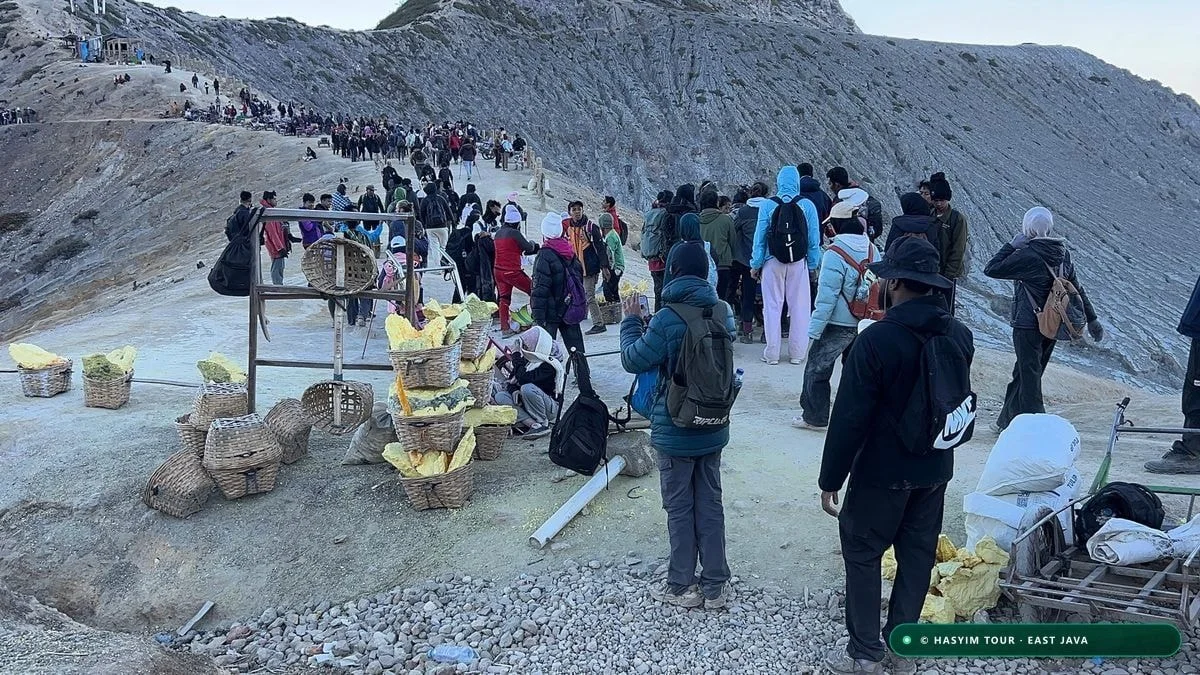
Climbing Kawah Ijen is far more than a physical fitness test or an opportunity for Instagram photography. It brings visitors face to face with one of the most intense, humbling human realities on the planet: the daily labor of traditional sulfur miners (*penambang belerang*), primarily belonging to the indigenous Osing ethnic community and agricultural villages surrounding the volcano (Tamansari, Licin, Glagah).
Operating under an artisanal mining concession managed by PT Candi Ngrimbi since 1968, the sulfur deposit at Ijen is harvested entirely without heavy machinery. To channel magmatic gases, miners have engineered networks of ceramic pipes and steel casings anchored into the solfatara vents. As gases travel through these conduits, they cool, condense, and discharge as glowing molten sulfur that hardens upon contact with the open air into brilliant canary-yellow solid slabs.
Armed only with steel pry bars, working amid dense acidic clouds that would disintegrate synthetic fabrics within weeks, miners manually break apart these slabs of 99%-pure elemental sulfur. They pack the heavy blocks into twin woven bamboo baskets balanced on a flexible wooden shoulder yoke (*pikulan*). The average load carried on a single bare shoulder weighs between 70 and 90 kilograms (155 to 200 lbs)—routinely exceeding the body weight of the carrier. To learn how direct bookings empower local miners with dignified wages, read our transparent guide to tour prices and direct booking benefits.
Shouldering this staggering weight, miners first haul their cargo up the steep, 800-meter rocky wall of the inner caldera (250 vertical meters at a 30% incline), followed by a 3-kilometer descent down the mountain to the weighing station at Pos 2 (Pondok Bunder) and the Paltuding depot. For this monumental effort, repeated once or twice each night, they earn a piece-rate wage of roughly IDR 1,150 to 1,250 per kilogram (about $0.07 to $0.08 USD per kg), yielding an average payout of IDR 90,000 to 180,000 ($6 to $11 USD) per trek.
Hasyim Tour was founded on direct, unwavering solidarity with this hardworking community. Our founder Hasyim was born into a Tamansari mining family, and all our guides are former sulfur carriers or miners' sons. When you encounter a miner on the steep trail, the golden rule is absolute: **always yield right-of-way immediately**, stepping to the inside mountain wall (never toward the cliff edge). Support their livelihoods by purchasing small hand-poured sulfur animal carvings (IDR 20,000 to 50,000) or providing generous tips and bottled water.
"My father carried 80 kilos of sulfur on his bare back to pay for my schooling. Today, our guiding agency allows miners' children to become certified mountain guides while ensuring fair wages flow directly to the village."
| Role in the Crater | Working Conditions | Average Load Weight | Approximate Income (IDR) | Ethical Traveler Protocol |
|---|---|---|---|---|
| Quarry Miner (Front) | Direct exposure to hot SO₂ gas | Steel crowbar, 20-30 kg chunks | Included in final weighing | Keep safe distance, do not obstruct work |
| Sulfur Carrier (Pikulan) | Climbing 30% inner crater wall | 70 to 90 kg on single shoulder | IDR 1,150 - 1,250 / kg (~$6-$11/trip) | Absolute right-of-way on all trails |
| Mountain Taxi Driver | Pushing wheeled cart on trail | Carrying tired tourists uphill | IDR 600,000 - 800,000 / trip | Dignified alternative work for elder miners |
| Sulfur Artisan Carver | Molding hot sulfur in cold water | Handcrafted figurines (100-300g) | IDR 20,000 - 50,000 per piece | Purchase directly without aggressive bargaining |
- Unchanged manual tradition: artisanal hand mining operating for more than 50 years inside the crater.
- Incredible physical loads: twin bamboo baskets (pikulan) weighing 70 to 90 kg balanced on a single shoulder.
- Piece-rate compensation: roughly IDR 1,200 per kg carried (~IDR 100,000 / $6.50 USD per 80 kg trip).
- Vital trail etiquette: always step to the mountain wall side to yield unhindered right-of-way to loaded miners.
- Direct community impact: purchase carved sulfur figurines (IDR 20k-50k) and support local village education.
Safety Protocols and Certified ABEK1 Respirators
KEY SUMMARY: To neutralize hazardous acid gases, wearing a certified silicone half-face respirator equipped with EN 14387 ABEK1 chemical cartridges is strictly mandatory. Hasyim Tour provides properly sanitized, certified respirators to all travelers at no additional cost.
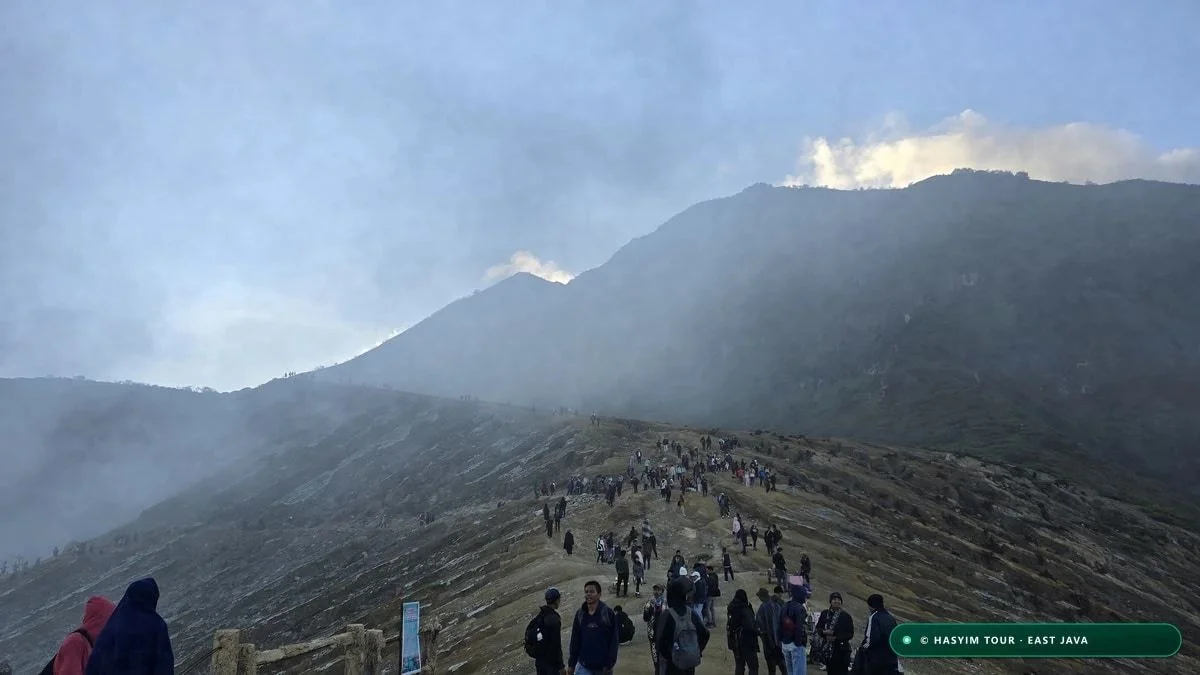
Given the severe toxicity of Kawah Ijen's atmosphere, personal protective equipment (PPE) must never be compromised. Too many ill-informed travelers arrive at the trailhead equipped only with flimsy paper surgical masks, wet bandanas, or counterfeit industrial masks completely devoid of active chemical filtering media.
To guarantee complete respiratory safety, our agency equips every single guest with a professional half-face silicone respirator (authentic 3M 6200 or 7502 series). Featuring a patented downward-facing exhalation valve that prevents lens fogging on glasses and goggles, these respirators create an airtight seal against the face via a fully adjustable four-point head harness.
Secured to the twin bayonet fittings are certified combination chemical cartridges meeting European standard EN 14387 class ABEK1 (or equivalent NIOSH Organic Vapor / Acid Gas standards). This classification represents a specific defense: 'A' filters organic gases; 'B' filters inorganic gases; 'E' specifically neutralizes acidic gases including sulfur dioxide ($SO_2$) and hydrogen chloride ($HCl$); and 'K' stops ammonia derivatives.
Inside each cartridge lies a packed bed of micro-granulated activated carbon chemically impregnated with alkaline metal salts that permanently trap acidic molecules through chemisorption. When paired with snap-on particulate pre-filters (3M 5N11, class P2/P3) to stop fine volcanic ash and liquid acid aerosols, this setup provides a proven filtration efficacy exceeding 99.9%. All our expeditions include certified ABEK1 masks. You can book directly via WhatsApp with Hasyim or read reviews from previous adventurers.
Before beginning the descent into the crater, your Hasyim Tour guide personally performs a Negative Pressure Fit Check: by covering the cartridge inlets with the palms of your hands and inhaling gently, the mask must pull firmly against your face without any perimeter air leaks. For travelers with thick beards that disrupt the silicone seal, our guides fit additional strap tensioners and provide airtight goggles to ensure complete comfort.
"A genuine respirator does not just block the bad smell: it allows you to breathe clean, purified air inside a gas cloud where an unprotected person would lose consciousness in two minutes."
| Respirator Equipment Type | Filtering Technology | Efficacy Against Gaseous SO₂ | Regulatory Standards | Status on Hasyim Tours |
|---|---|---|---|---|
| Surgical / Cloth Mask | Simple woven fabric barrier | 0% (Completely useless) | No gas filtration rating | STRICTLY FORBIDDEN in crater |
| Dust Mask (FFP2 / N95) | Electrostatic fibers (Particulate) | < 5% (Acid gas passes freely) | EN 149 (Dust only) | UNSAFE and prohibited |
| Single-Canister Military Mask | Heavy front screw-on filter | Variable (Often expired surplus) | Unverified military surplus | Not recommended (Uncomfortable) |
| 3M Silicone Mask + ABEK1 | Impregnated activated carbon bed | > 99.9% acid gas neutralization | EN 14387 ABEK1 / NIOSH | OFFICIAL STANDARD on all tours |
| Full-Face Panoramic Mask | Integrated sealed visor + filters | 100% (Full eye + lung defense) | EN 136 Class 2 | Available upon advance request |
- Professional silicone half-masks: 4-point ergonomic head harness ensuring an airtight facial seal.
- Certified EN 14387 ABEK1 cartridges: complete chemical neutralization of SO₂, HCl, and acid vapors.
- P2/P3 particulate pre-filters: blocks fine volcanic ash and airborne droplets of sulfuric acid mist.
- Mandatory seal check: hands-on negative pressure testing conducted by your guide before crater descent.
- Free premium gear: included as standard, inspected, and sanitized after every single expedition.
Frequently Asked Questions
Frequently Asked Questions about the Trek
Is Kawah Ijen's blue fire visible every night of the year?
The geological combustion of sulfuric gas takes place continuously 365 days a year. However, visual observation depends entirely on weather: during the dry season (May to October), clear skies offer an 85%+ chance of perfect viewing, while peak monsoon season (December to March) can obscure the flames behind dense acidic steam.
Why do the blue flames disappear at sunrise?
The blue light emitted by burning sulfur has low photometric luminance. As morning twilight breaks around 04:45 AM, ambient sunlight scatters through the atmosphere and overwhelms the blue wavelength, rendering the flames invisible to the naked eye. The fire still burns, but only white smoke can be seen.
Is it dangerous to hike down into Kawah Ijen's crater?
Descending into the caldera carries genuine risks due to steep rocky terrain (30% grade) and high concentrations of toxic sulfur dioxide (SO₂). When accompanied by a certified local guide, wearing a sealed professional ABEK1 gas mask, and using a bright headlamp, the descent is safe and manageable.
What is the difference between an N95 mask and an ABEK1 respirator?
An N95 or FFP2 dust mask only filters solid particles and allows toxic gases like sulfur dioxide to pass straight through into your lungs. A certified ABEK1 respirator contains chemical cartridges packed with impregnated activated carbon that actively captures and neutralizes acid gas molecules.
How long does the hike down to the blue fire take?
From the crater rim (2,386 m), the path drops 250 vertical meters over 800 meters of rough rocks. The descent takes 40 to 50 minutes of careful walking. Climbing back up to the rim requires approximately 45 to 60 minutes depending on your physical stamina.
Can I take good photos of the blue fire using a smartphone?
Modern flagship smartphones with dedicated Night Mode (iPhone 14/15/16 Pro, Google Pixel 8/9, Samsung S23/S24 Ultra) can capture decent handheld shots. However, to capture the intricate texture of the flames and the dark volcanic rocks without noise, a mirrorless camera on a sturdy tripod is highly recommended.
What is the proper etiquette around the sulfur miners?
Miners carry heavy loads of 70 to 90 kg on a narrow path. You must always yield right-of-way by stepping to the inside mountain wall (never toward the cliff). Do not shine bright lights or flashes into their eyes without permission, and support their families by buying small sulfur carvings for IDR 20,000 to 50,000.
What should I do if a sudden wind gust blows a sulfur cloud toward us?
Stay calm: if your ABEK1 respirator is properly sealed, you can breathe normally without inhaling acidic fumes. Squint or close your eyes to prevent stinging, turn your back to the wind, and follow your guide, who will lead you a few steps out of the plume into fresh air.
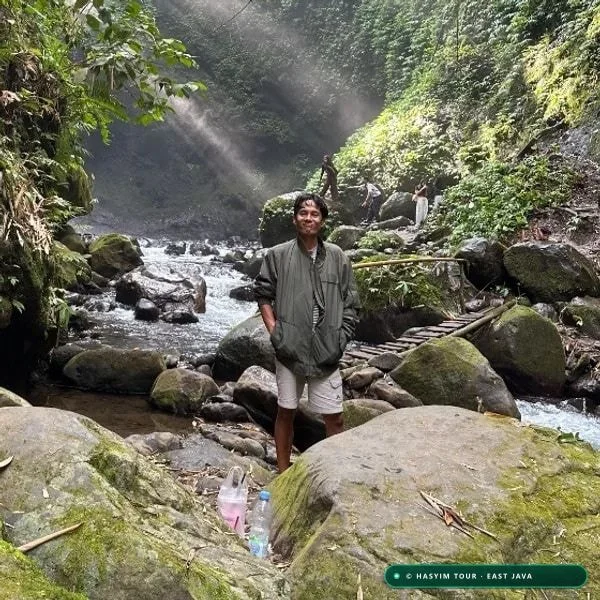
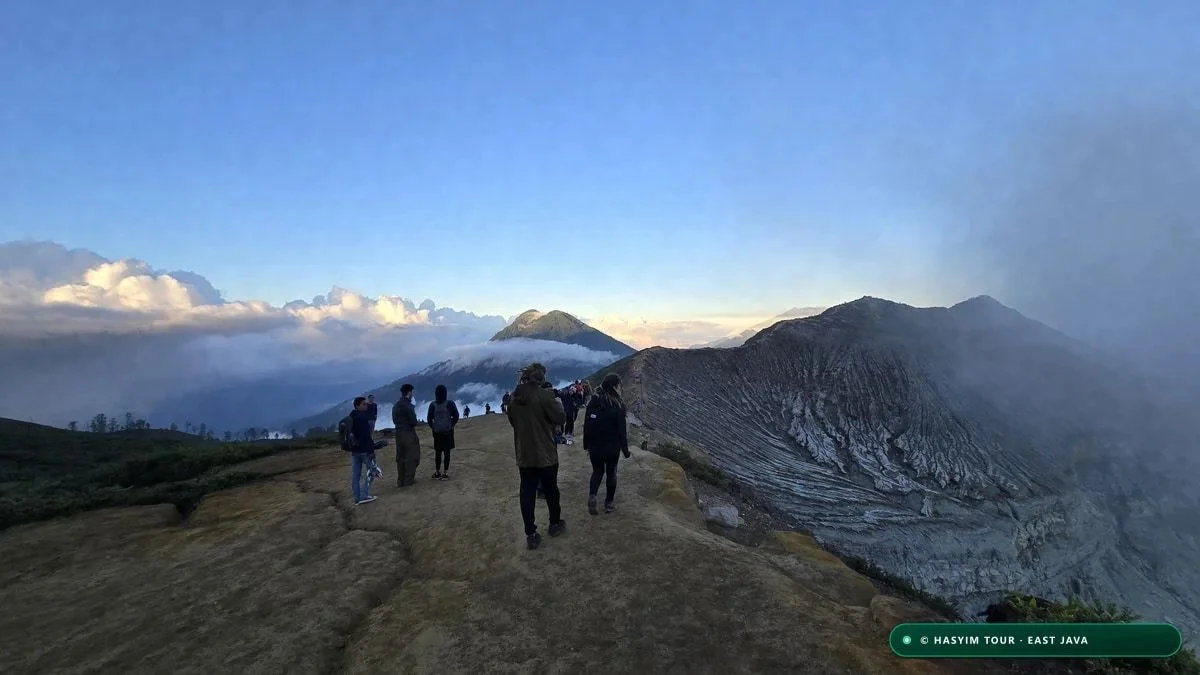
Best Time to Visit Kawah Ijen: Weather & Blue Fire Guide
Month-by-month weather matrix, nocturnal temperatures (5-12°C), and ideal blue fire viewing conditions.
Mount Bromo & Kawah Ijen Complete Trekking Guide (2026 Edition)
Complete reference manual: 15-criteria comparative matrix, atmospheric lapse rate model, and respiratory toxicology.
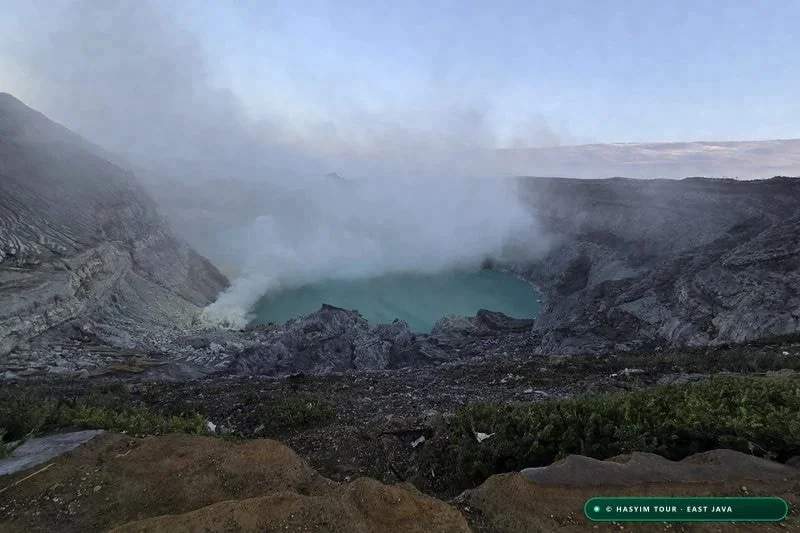
Kawah Ijen & Mount Bromo Tour Prices 2026: Real Costs, Tickets & Direct Local Guide
Total pricing transparency: official national park permits, certified ABEK1 respirators, 4x4 Jeeps, and direct booking benefits.