Apa itu Api Biru? Kimia dan Termodinamika
RINGKASAN UTAMA: Api biru Kawah Ijen berasal dari pembakaran spontan uap belerang murni yang menyembur pada suhu di atas 600°C saat bereaksi dengan oksigen udara. Reaksi eksotermik ini menciptakan lidah api biru kobalt setinggi hingga 5 meter.
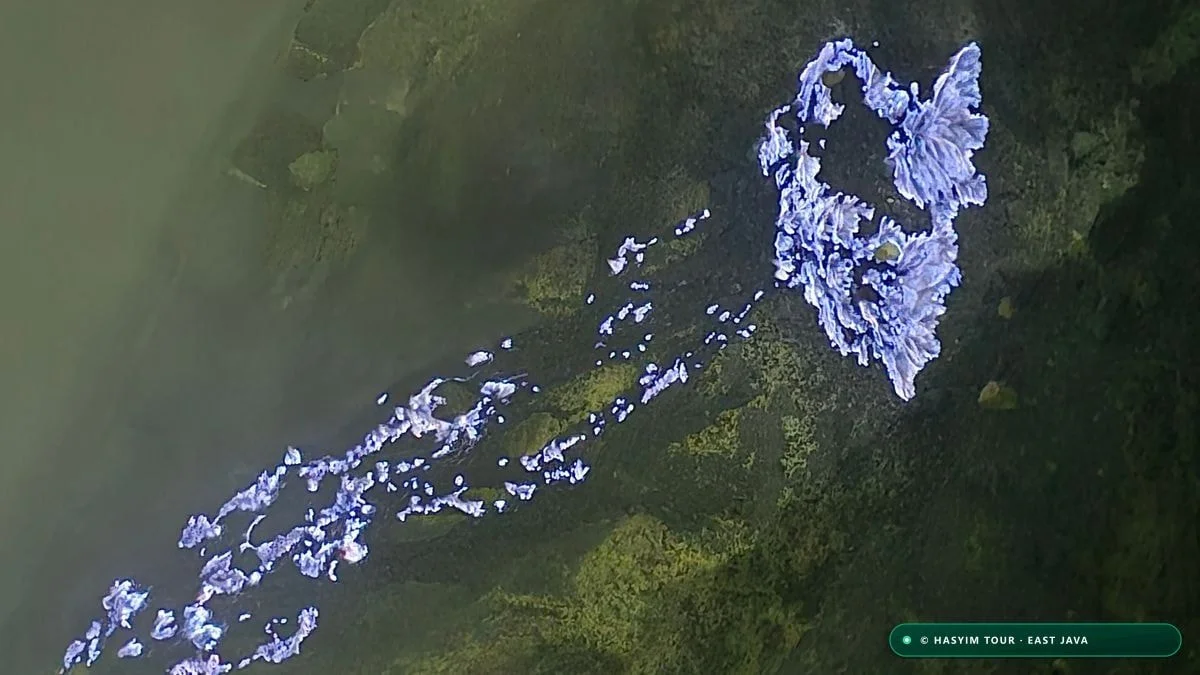
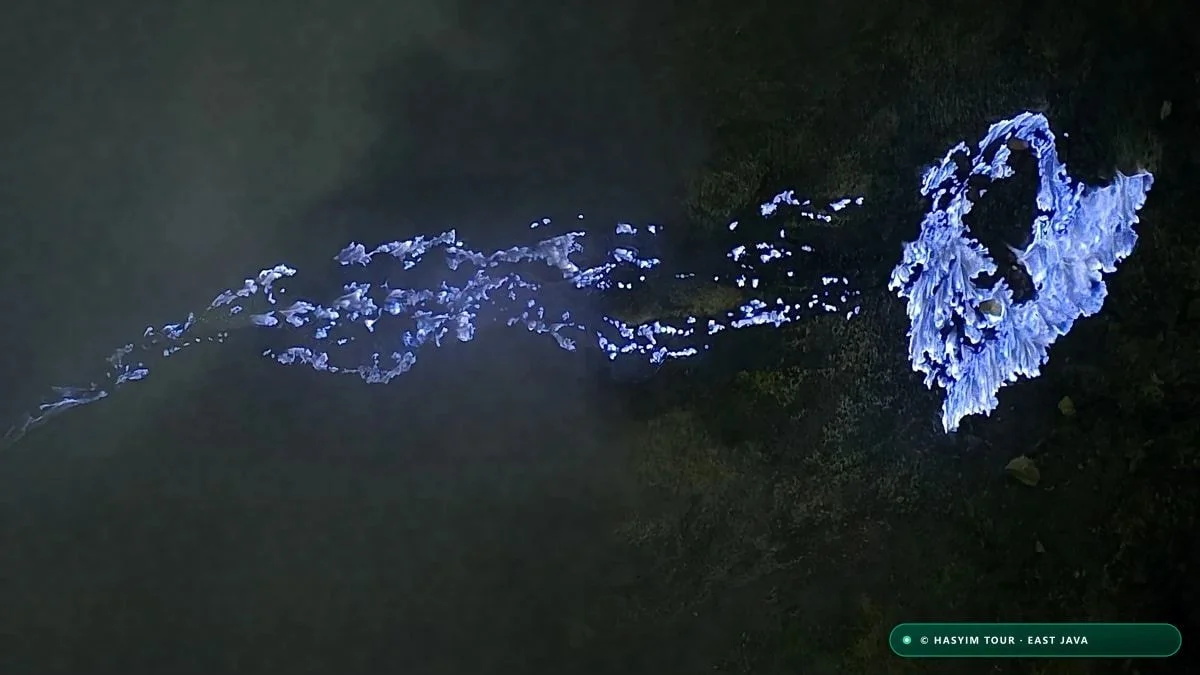
Di berbagai platform media sosial, api biru Kawah Ijen kerap disebut sebagai 'lava biru'. Namun secara ilmu geologi dan mineralogi, lava batuan vulkanik bersuhu tinggi selalu berpendar merah jingga, tidak pernah berwarna biru. Fenomena malam hari di Kawah Ijen adalah pembakaran gas belerang suhu tinggi yang sangat eksotermik.
Dua kilometer di bawah kaldera, kantong magma aktif melepaskan fluida hidrotermal dan gas magmatik pekat bertekanan tinggi. Gas ini kaya akan uap belerang murni (S₂ dan rantai S₈), sulfur dioksida (SO₂), dan hidrogen sulfida (H₂S) yang menyembur keluar dari pipa solfatara pada suhu antara 450°C hingga lebih dari 600°C.
Ketika gas belerang bersuhu tinggi ini bertemu dengan oksigen di udara terbuka, gas langsung terbakar spontan karena suhunya melampaui titik nyala belerang (~360°C). Reaksi oksidasi cepat ini melepaskan energi panas dan nyala api biru kobalt yang spektakuler.
Warna biru terang tersebut berasal dari proses fisika kuantum saat molekul belerang yang teraktivasi memancarkan foton cahaya pada panjang gelombang 400 hingga 450 nanometer (spektrum biru dan nila). Untuk mengetahui bulan-bulan dengan langit terbersih, simak panduan waktu terbaik dan musim berkunjung ke Kawah Ijen.
Pada saat bersamaan, suhu udara malam yang dingin mengembunkan sebagian uap belerang menjadi cairan pada suhu 115°C hingga 120°C. Cairan belerang membara ini mengalir menuruni tebing batu, menyerupai air terjun lava biru bercahaya yang mengalir ke danau kawah asam.
"It is not lava, it is the gaseous soul of the Earth igniting upon touch with the night air. Pure magmatic energy venting at over 600°C."
| Parameter Fisika / Kimia | Nilai Terukur di Ijen | Mekanisme Geokimia | Dampak Visual Malam Hari |
|---|---|---|---|
| Vent Gas Temperature | 450°C to 600°C | Superheated deep magmatic fluids | Invisible before combustion, bright blue flames |
| Autoignition Threshold | ~360°C (at 1 atm) | Spontaneous exothermic oxidation in air | Instantaneous ignition upon emergence |
| Sulfur Melting Point | 115°C to 120°C | Phase transition from gas to dense liquid | Cascades of molten burning blue sulfur |
| Spectral Wavelength | 400 - 450 nm | Radiative emission from excited S₂ molecules | Electric cobalt blue, indigo, violet hues |
| Flame Jet Height | 1 to 5 meters | High venting pressure and solfatara turbulence | Vertical dancing torches over ceramic pipes |
- Spontaneous gas-phase combustion: autoignition of pure sulfur vapors (S₂) at 360°C+ upon contact with atmospheric oxygen.
- Quantum molecular spectroscopy: radiative relaxation emitting photons in the 400-450 nm wavelength band (cobalt blue).
- Liquid sulfur cascades: condensation at 115°C flowing as burning streams down the dark caldera walls.
- High-pressure vent temperature: deep magmatic fumaroles continuously measured between 450°C and 600°C.
Kapan Waktu Pengamatan Terbaik? Jadwal Malam
RINGKASAN UTAMA: Api biru hanya dapat disaksikan dalam kegelapan malam pekat antara pukul 02.00 hingga 04.30 WIB. Mulai pukul 04.45 WIB, sinar fajar pagi akan menyamarkan pendaran biru hingga tak terlihat lagi.
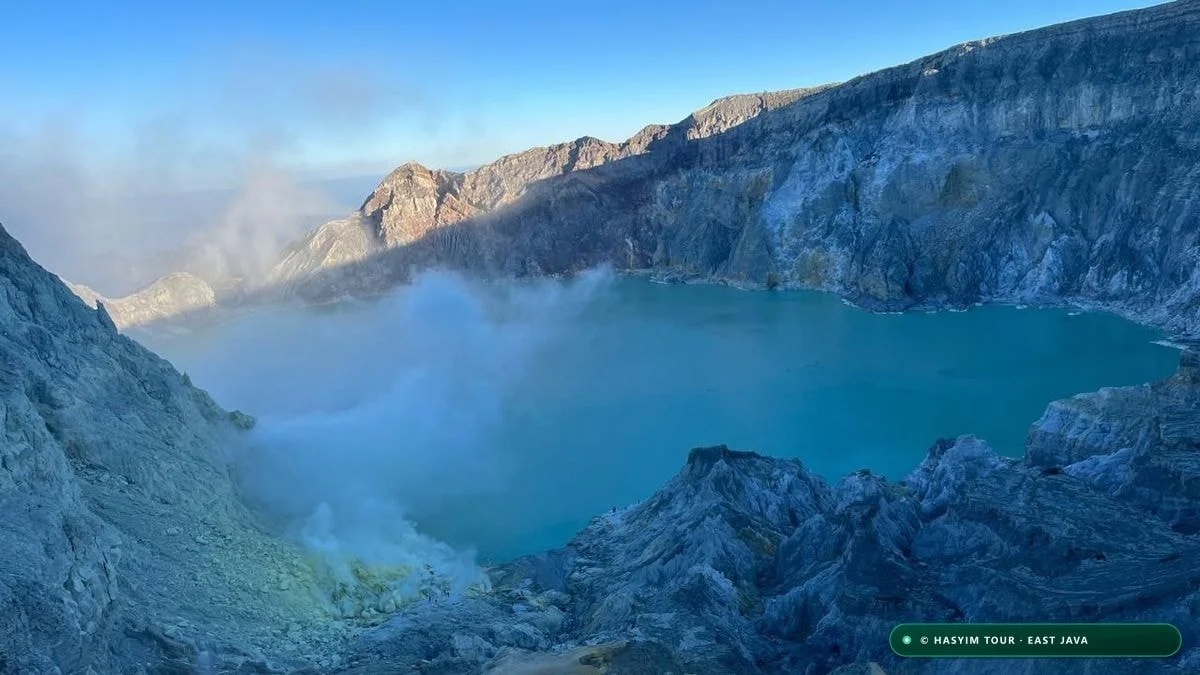
Meskipun gas belerang terbakar terus menerus selama 24 jam sehari, intensitas cahaya api biru tergolong redup bila dibandingkan dengan cahaya matahari. Pada siang hari, sinar matahari menyamarkan warna biru sehingga hanya terlihat asap putih tebal.
Pengamatan yang optimal memerlukan kegelapan malam total (< 0,01 lux). Jendela waktu pengamatan ini akan tertutup begitu fajar astronomi menyingsing sekitar pukul 04.45 WIB di ufuk timur Selat Bali.
Gerbang pos pendakian Paltuding dibuka tepat pukul 02.00 WIB. Pendaki menempuh jarak 3 km (1,5 jam) ke bibir kawah sebelum langsung menuruni jalur terjal menuju dasar kawah. Pendakian malam ini termasuk dalam paket tur privat 2H1M Kawah Ijen bersama tim pemandu lokal resmi.
Jalur turun berbatu sejauh 800 meter dengan penurunan 250 meter elevasi memakan waktu 40 hingga 50 menit dengan bantuan senter kepala. Tiba sebelum pukul 04.00 WIB memberi waktu 30 hingga 45 menit untuk menyaksikan api biru dari jarak dekat.
Keterlambatan berangkat dari hotel di Banyuwangi (penjemputan antara 00.00 hingga 00.30 WIB) akan mengurangi waktu Anda di dasar kawah secara signifikan.
"The mountain waits for no one: at 04:45 AM, the curtain falls on the blue fire. Every minute gained leaving at midnight is an extra minute of pure magic inside the crater."
| Rentang Waktu (WIB) | Titik Lokasi Jalur | Pencahayaan Langit Alami | Kualitas Pengamatan Api Biru | Tindakan yang Disarankan |
|---|---|---|---|---|
| 00:15 - 01:15 AM | Transfer Banyuwangi -> Paltuding | Pitch-black night | N/A (En route) | Inspect headlamps, warm layers, and masks |
| 01:15 - 02:00 AM | Paltuding Basecamp (1,850 m) | Pitch-black night | N/A (Trailhead) | BKSDA permit registration, negative pressure test |
| 02:00 - 03:20 AM | Ascending outer flank trail (3 km) | Starry night sky | N/A (Outer slope) | Steady cardio pacing, controlled hydration |
| 03:20 - 04:00 AM | Descent into rocky caldera (800 m) | Dark crater void | Flames visible from mid-way down | ABEK1 respirator sealed, careful footing |
| 04:00 - 04:35 AM | Solfatara vents by acidic lake | Total darkness | PEAK RADIANCE (100% Saturation) | Contemplative viewing, tripod photography |
| 04:35 - 05:10 AM | Climb back to summit crater rim | Early astronomical dawn | Rapid fading of blue hue (30%) | Ascend steadily before crowds congest trail |
| 05:15 - 06:15 AM | Eastern rim viewpoint (2,386 m) | Golden morning sunrise | Flames invisible, dense steam | Sunrise over Bali Strait, turquoise lake photos |
- Absolute viewing window: 02:00 to 04:30 AM, with peak chromatic saturation between 03:15 and 04:15 AM.
- Critical optical fade point: 04:45 AM, as astronomical dawn washes out the cobalt blue spectrum.
- Standard expedition pacing: 02:00 AM Paltuding departure, 03:25 AM crater rim, 04:05 AM blue fire arrival.
- Demanding crater descent: 800 meters on rough scree and rocks, dropping 250 vertical meters under gas masks.
Toksikologi Belerang dan Batas Bahaya (PPM)
RINGKASAN UTAMA: Udara kawah mengandung gas sulfur dioksida (SO₂) berbahaya dengan lonjakan hingga 30-60 ppm. Menghirup gas ini tanpa masker kimia respirator memicu iritasi dan luka bakar saluran napas.
Menuruni kaldera Kawah Ijen berarti memasuki laboratorium kimia vulkanik alam terbuka. Asap solfatara mengandung lebih dari 90% gas berbahaya seperti sulfur dioksida ($SO_2$), hidrogen sulfida ($H_2S$), dan asam klorida ($HCl$).
Sulfur dioksida sangat mudah larut dalam air. Saat terhirup tanpa pelindung, gas ini langsung bereaksi dengan cairan lembap di saluran pernapasan membentuk asam sulfat ($H_2SO_4$) yang sangat korosif.
Standar keselamatan kerja membatasi batas aman paparan gas SO₂ maksimal 5 ppm, sementara 100 ppm langsung mengancam jiwa (IDLH). Di dasar kawah, hembusan angin dapat menaikkan konsentrasi gas secara mendadak hingga 30-60 ppm.
Masker kain atau masker N95 sama sekali **tidak mampu menyaring gas asam**, karena molekul gas dapat menembus serat penyaring debu. Wajib mengenakan masker respirator half-face dengan cartridge kimia karbon aktif ABEK1.
Pengelola taman wisata alam (BBKSDA) mewajibkan setiap pendaki membawa Surat Keterangan Sehat dari klinik sebelum memulai pendakian.
"Sulfur dioxide is liquid acid disguised as gas: the second it touches moisture in your throat or eyes, it burns. Never descend into the caldera without certified chemical cartridges."
| Konsentrasi SO₂ (ppm) | Gejala Fisiologis pada Manusia | Klasifikasi Toksikologi | Batas Waktu Paparan Aman | Tindakan Darurat Segera |
|---|---|---|---|---|
| 0.3 - 1.5 ppm | Distinct matchstick sulfur odor detected | Olfactory sensory threshold | Indefinite without harm | Check respirator face seal and tightness |
| 3.0 - 5.0 ppm | Mild nasal prickling, slight throat dryness | OSHA permissible legal limit | 8 hours max (with mask) | Tighten elastic head harness straps |
| 10.0 - 20.0 ppm | Violent reflexive coughing, tearing eyes | Acute short-term hazard zone | < 2 minutes unprotected | Turn back to the wind and step out of plume |
| 30.0 - 60.0 ppm | Severe bronchospasms, gasping, eye burning | Critical hazard zone (Ijen plume) | < 30 seconds unprotected | Ascend immediately toward upper crater rim |
| > 100.0 ppm | Alveolar burns, loss of consciousness, edema | IDLH (Immediate Threat to Life) | Zero tolerance | Emergency evacuation assisted by tour guide |
- Toxic gas composition: dominated by SO₂ (sulfur dioxide), forming corrosive sulfuric acid upon mucosal contact.
- Regulatory safety ceilings: OSHA safe limit of 5 ppm, with crater spikes routinely reaching 30-70 ppm in wind eddies.
- Lethal IDLH threshold (100 ppm): immediate risk of acute pulmonary edema and chemical suffocation.
- Uselessness of dust masks: N95/FFP2 masks offer zero defense against gaseous acid vapors.
- Mandatory medical clearance: Surat Keterangan Sehat health certificate required by park authorities.
Perbandingan Global: Ijen vs Dallol vs Merapi
RINGKASAN UTAMA: Kawah Ijen merupakan satu dari hanya dua lokasi di bumi dengan api biru abadi. Dibandingkan Dallol di Ethiopia, Ijen unggul dengan akses mudah, danau kawah asam terluas, dan pemandu lokal berlisensi.
Dari ribuan gunung berapi di bumi, hanya Kawah Ijen di Jawa Timur dan depresi hidrotermal Dallol di Ethiopia yang memiliki fenomena api biru secara permanen.
Dallol terletak di padang garam tandus bersuhu 50°C di bawah permukaan laut dan memerlukan pengawalan militer, serta tidak memiliki danau kawah megah.
Sebaliknya, Kawah Ijen sangat mudah dijangkau dari Bali atau Surabaya dan memiliki danau kawah asam berwarna toska seluas 36 juta meter kubik dengan tingkat keasaman ekstrem pH 0,2.
"Ijen is an unparalleled geological cathedral: nowhere else on Earth can you watch 5-meter blue flames lick the shores of the world's largest acid lake."
| Lokasi Vulkanik | Letak Geografis | Tipe Fenomena Api Biru | Suhu Gas Vulkanik | Keberadaan Danau Asam | Aksesibilitas & Risiko |
|---|---|---|---|---|---|
| Kawah Ijen | East Java, Indonesia | Permanent blue flames (1-5 m) + liquid flows | 450°C to 600°C | Yes (pH 0.2, 36M m³) | Accessible (2h night hike, certified guides) |
| Dallol (Danakil) | Afar Depression, Ethiopia | Fleeting blue flickers over salt vents | 350°C to 500°C | No (Shallow hyper-saline pools) | Extremely arduous (50°C heat, armed guard) |
| Mount Merapi | Central Java, Indonesia | Rare blue flashes during gas explosions | 250°C to 400°C | No (Active andesitic lava dome) | Closed to public (Deadly pyroclastic risk) |
| Yellowstone Park | Wyoming, United States | Accidental burning of thermal sulfur crust | 150°C to 280°C | No (Neutral/alkaline hot springs) | Highly regulated (Strict boardwalk paths) |
| Poás Volcano | Central Range, Costa Rica | Smelly fumaroles without visible flames | 180°C to 320°C | Yes (Laguna Caliente, pH 0.5) | Developed overlook (Strict tourist access) |
- Planetary rarity: only two permanent blue fire volcanic sites exist globally (Ijen and Dallol).
- Largest acidic lake on Earth: 36 million m³ of turquoise water loaded with sulfuric and hydrochloric acid at pH 0.2.
- Superb accessibility: 1.5-hour flight/ferry connection from Bali with modern hotels in Banyuwangi.
- Structured safety oversight: certified local mountain guides and active BKSDA ranger stations each night.
Perjuangan Penambang Belerang dan Pariwisata Etis
RINGKASAN UTAMA: Sekitar 200 penambang tradisional memikul keranjang belerang 70 hingga 90 kg setiap malam. Selalu beri jalan prioritas kepada mereka dan beli suvenir belerang untuk mendukung perekonomian mereka.
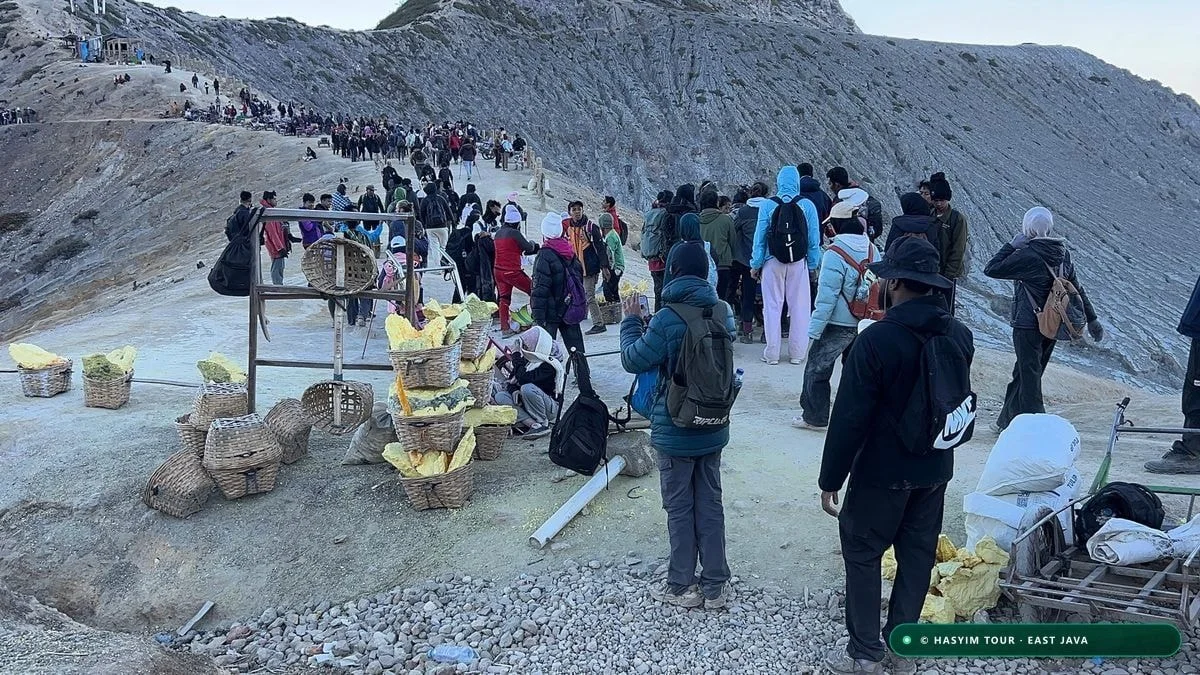
Penambangan belerang di Kawah Ijen telah berlangsung lebih dari setengah abad secara tradisional tanpa alat berat. Gas belerang dialirkan melalui pipa hingga membeku menjadi lempengan kuning cerah.
Penambang memecah lempengan belerang dan memikul beban seberat 70 hingga 90 kilogram menggunakan keranjang bambu (*pikulan*) di atas satu pundak.
Mereka mendaki tebing curam 250 meter lalu berjalan turun sejauh 3 km ke pos timbang dengan upah sekitar Rp 1.200 per kilogram. Untuk memahami bagaimana pemesanan langsung mendukung ekonomi para penambang, simak transparansi rincian biaya paket wisata kami.
Hasyim Tour memberdayakan komunitas penambang lokal. Berikan jalan prioritas di sisi tebing dalam dan dukung mereka dengan membeli patung kerajinan belerang (Rp 20.000 - Rp 50.000).
"My father carried 80 kilos of sulfur on his bare back to pay for my schooling. Today, our guiding agency allows miners' children to become certified mountain guides while ensuring fair wages flow directly to the village."
| Peran di Dalam Kawah | Kondisi Lingkungan Kerja | Beban Muatan Rata-rata | Perkiraan Penghasilan (IDR) | Etika Wisatawan yang Bertanggung Jawab |
|---|---|---|---|---|
| Quarry Miner (Front) | Direct exposure to hot SO₂ gas | Steel crowbar, 20-30 kg chunks | Included in final weighing | Keep safe distance, do not obstruct work |
| Sulfur Carrier (Pikulan) | Climbing 30% inner crater wall | 70 to 90 kg on single shoulder | IDR 1,150 - 1,250 / kg (~$6-$11/trip) | Absolute right-of-way on all trails |
| Mountain Taxi Driver | Pushing wheeled cart on trail | Carrying tired tourists uphill | IDR 600,000 - 800,000 / trip | Dignified alternative work for elder miners |
| Sulfur Artisan Carver | Molding hot sulfur in cold water | Handcrafted figurines (100-300g) | IDR 20,000 - 50,000 per piece | Purchase directly without aggressive bargaining |
- Unchanged manual tradition: artisanal hand mining operating for more than 50 years inside the crater.
- Incredible physical loads: twin bamboo baskets (pikulan) weighing 70 to 90 kg balanced on a single shoulder.
- Piece-rate compensation: roughly IDR 1,200 per kg carried (~IDR 100,000 / $6.50 USD per 80 kg trip).
- Vital trail etiquette: always step to the mountain wall side to yield unhindered right-of-way to loaded miners.
- Direct community impact: purchase carved sulfur figurines (IDR 20k-50k) and support local village education.
Protokol Keselamatan dan Masker Gas ABEK1
RINGKASAN UTAMA: Masker respirator silikon dengan filter kimia bersertifikat EN 14387 ABEK1 wajib dikenakan di kawah. Hasyim Tour menyediakan masker steril berstandar resmi ini tanpa biaya tambahan.
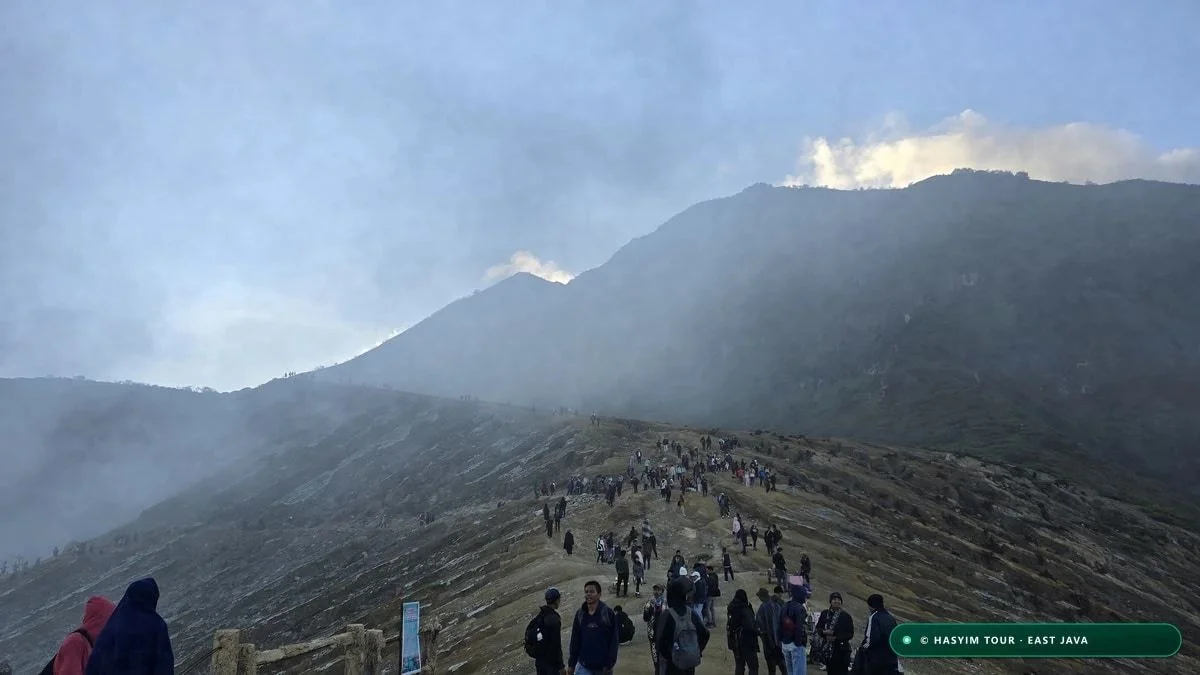
Kami melengkapi setiap tamu dengan masker respirator silikon resmi seri 3M yang kedap udara dan nyaman di wajah.
Filter ABEK1 bersertifikat resmi mampu mengikat gas sulfur dioksida dan uap asam dengan efektivitas penyaringan lebih dari 99,9%.
Pemandu melakukan uji kerapatan (*fit check*) sebelum turun ke dasar kawah untuk memastikan keamanan seluruh peserta. Semua ekspedisi kami sudah termasuk masker ABEK1 terstandarisasi. Anda dapat memesan langsung via WhatsApp bersama Mas Hasyim atau membaca ulasan para pendaki kami.
"Masker respirator asli tidak hanya menyaring bau: ini memungkinkan Anda menghirup udara bersih di tengah kepulan gas pekat di mana orang tanpa pelindung bisa kehilangan kesadaran dalam dua menit."
| Tipe Perlengkapan Pernapasan | Teknologi Filtrasi | Efektivitas Menangkal Gas SO₂ | Standar Regulasi Resmi | Status pada Tur Hasyim |
|---|---|---|---|---|
| Surgical / Cloth Mask | Simple woven fabric barrier | 0% (Completely useless) | No gas filtration rating | STRICTLY FORBIDDEN in crater |
| Dust Mask (FFP2 / N95) | Electrostatic fibers (Particulate) | < 5% (Acid gas passes freely) | EN 149 (Dust only) | UNSAFE and prohibited |
| Single-Canister Military Mask | Heavy front screw-on filter | Variable (Often expired surplus) | Unverified military surplus | Not recommended (Uncomfortable) |
| 3M Silicone Mask + ABEK1 | Impregnated activated carbon bed | > 99.9% acid gas neutralization | EN 14387 ABEK1 / NIOSH | OFFICIAL STANDARD on all tours |
| Full-Face Panoramic Mask | Integrated sealed visor + filters | 100% (Full eye + lung defense) | EN 136 Class 2 | Available upon advance request |
- Masker respirator silikon profesional: tali pengikat ergonomis 4 titik menjamin kerapatan kedap udara di wajah.
- Katrid ABEK1 bersertifikat EN 14387: netralisasi kimia total gas SO₂, asam klorida, dan uap asam berbahaya.
- Pra-filter partikulat P2/P3: menyaring abu vulkanik halus dan percikan aerosol kabut asam sulfat.
- Uji kerapatan wajib (fit check): pengujian tekanan negatif langsung dipandu sebelum menuruni kawah.
- Peralatan standar resmi gratis: disediakan gratis, diperiksa kelayakannya, dan disterilkan setelah setiap tur.
Pertanyaan yang Sering Diajukan
Pertanyaan yang Sering Diajukan
Is Kawah Ijen's blue fire visible every night of the year?
The geological combustion of sulfuric gas takes place continuously 365 days a year. However, visual observation depends entirely on weather: during the dry season (May to October), clear skies offer an 85%+ chance of perfect viewing, while peak monsoon season (December to March) can obscure the flames behind dense acidic steam.
Why do the blue flames disappear at sunrise?
The blue light emitted by burning sulfur has low photometric luminance. As morning twilight breaks around 04:45 AM, ambient sunlight scatters through the atmosphere and overwhelms the blue wavelength, rendering the flames invisible to the naked eye. The fire still burns, but only white smoke can be seen.
Is it dangerous to hike down into Kawah Ijen's crater?
Descending into the caldera carries genuine risks due to steep rocky terrain (30% grade) and high concentrations of toxic sulfur dioxide (SO₂). When accompanied by a certified local guide, wearing a sealed professional ABEK1 gas mask, and using a bright headlamp, the descent is safe and manageable.
What is the difference between an N95 mask and an ABEK1 respirator?
An N95 or FFP2 dust mask only filters solid particles and allows toxic gases like sulfur dioxide to pass straight through into your lungs. A certified ABEK1 respirator contains chemical cartridges packed with impregnated activated carbon that actively captures and neutralizes acid gas molecules.
How long does the hike down to the blue fire take?
From the crater rim (2,386 m), the path drops 250 vertical meters over 800 meters of rough rocks. The descent takes 40 to 50 minutes of careful walking. Climbing back up to the rim requires approximately 45 to 60 minutes depending on your physical stamina.
Can I take good photos of the blue fire using a smartphone?
Modern flagship smartphones with dedicated Night Mode (iPhone 14/15/16 Pro, Google Pixel 8/9, Samsung S23/S24 Ultra) can capture decent handheld shots. However, to capture the intricate texture of the flames and the dark volcanic rocks without noise, a mirrorless camera on a sturdy tripod is highly recommended.
What is the proper etiquette around the sulfur miners?
Miners carry heavy loads of 70 to 90 kg on a narrow path. You must always yield right-of-way by stepping to the inside mountain wall (never toward the cliff). Do not shine bright lights or flashes into their eyes without permission, and support their families by buying small sulfur carvings for IDR 20,000 to 50,000.
What should I do if a sudden wind gust blows a sulfur cloud toward us?
Stay calm: if your ABEK1 respirator is properly sealed, you can breathe normally without inhaling acidic fumes. Squint or close your eyes to prevent stinging, turn your back to the wind, and follow your guide, who will lead you a few steps out of the plume into fresh air.
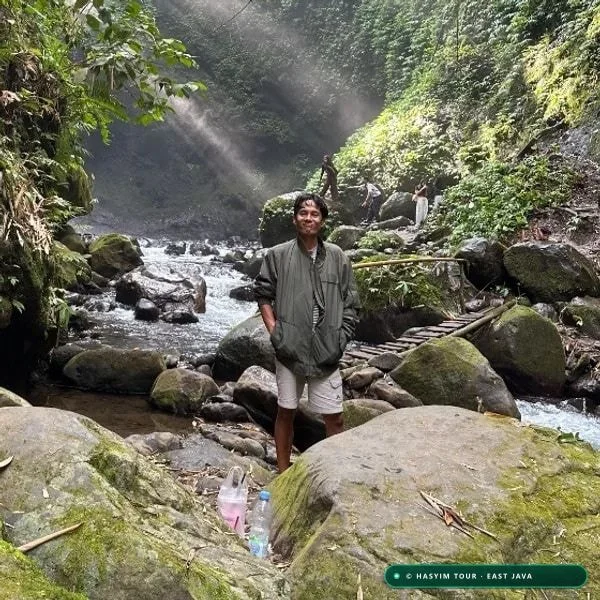
Waktu Terbaik Mengunjungi Kawah Ijen: Cuaca & Api Biru
Analisis cuaca bulanan, suhu malam di puncak (5-12°C), dan waktu optimal melihat api biru.
Panduan Lengkap Pendakian Kawah Ijen & Gunung Bromo (Edisi 2026)
Panduan referensi: matriks perbandingan 15 kriteria, model fisik penurunan suhu adiabatik, dan keamanan gas.
Harga Paket Wisata Kawah Ijen & Bromo 2026: Rincian Biaya, Tiket & Guide Lokal
Transparansi biaya total: tiket resmi taman nasional, masker gas ABEK1, jip 4x4, dan keuntungan memesan langsung.